Introduction
A lead magnet is not just a free resource. It is the first exchange of value between your business and a potential subscriber.
Someone gives you their email address because they believe your offer will help them solve a specific problem, make a decision, or move closer to a result they want.
That exchange matters.
A weak lead magnet may collect emails, but it rarely creates trust. A strong lead magnet gives the right person a useful win and makes the next step feel natural.
The best lead magnets are specific, easy to understand, and closely connected to the problem your business solves. They do not try to impress everyone. They help one audience make meaningful progress.
This guide explains what lead magnets are, why they work, how to choose the right format, how to create one, and how to measure whether it attracts qualified leads instead of empty subscribers.
Key Takeaways
- A lead magnet is a focused offer given in exchange for contact information or permission to continue the relationship.
- The best lead magnets solve one clear problem for one specific audience.
- A strong lead magnet proves your value before asking for a sale.
- Format matters less than fit. A checklist, template, quiz, guide, webinar, or free trial only works when it matches what the audience needs next.
- Immediate usefulness usually beats broad education because people want progress, not more content to manage.
- The lead magnet should connect naturally to the next offer, email sequence, or sales conversation.
- Performance should be measured by lead quality, email engagement, pipeline, and revenue, not opt-ins alone.
- A lead magnet should be updated when its examples, tools, data, or recommendations no longer support the promise.
Affiliate Disclosure: Some of the links on this site are affiliate links. That means if you click and make a purchase, I may earn a small commission at no extra cost to you.
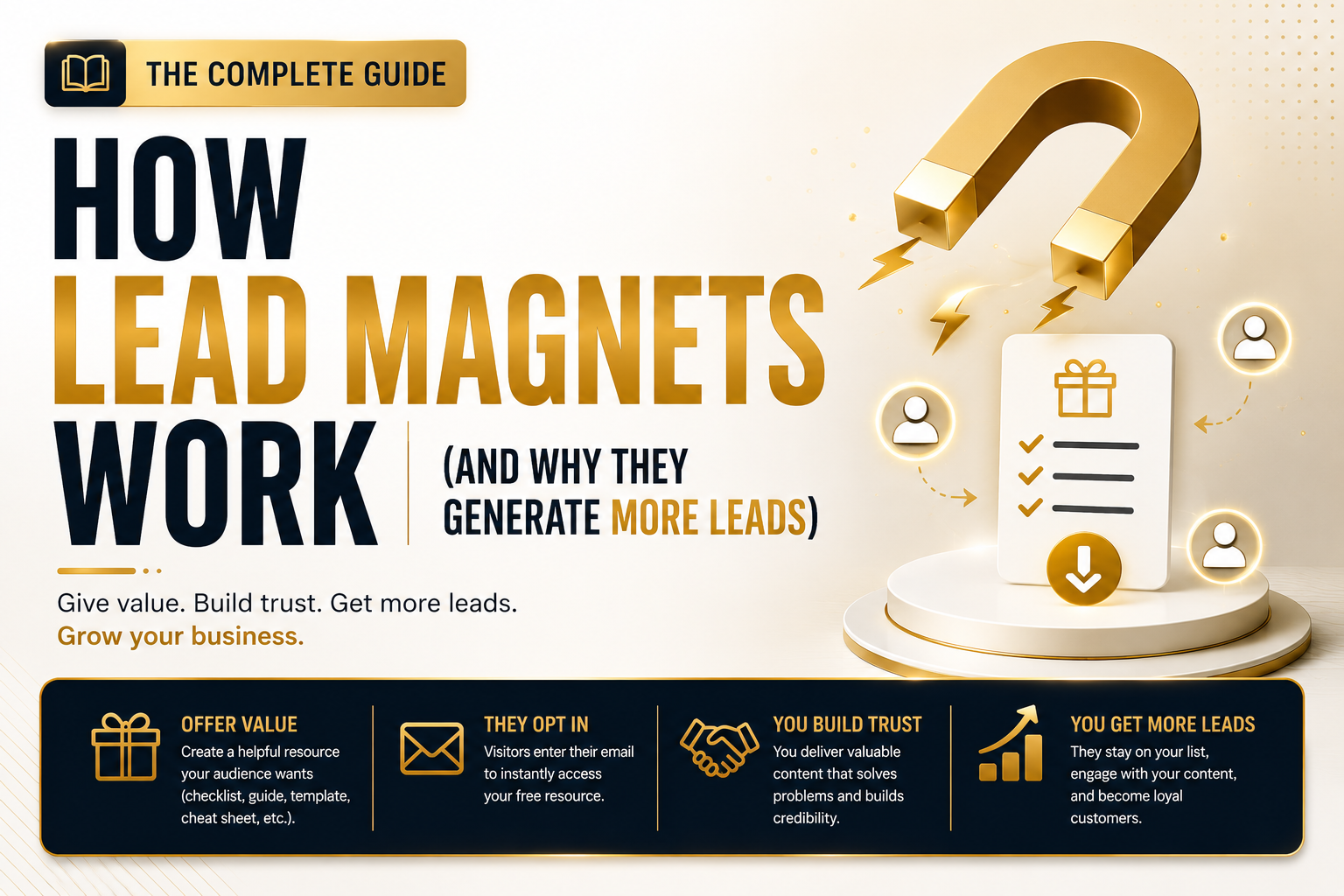
What Is A Lead Magnet?
A lead magnet is a useful offer given in exchange for contact information, usually an email address.
The exchange is simple.
The visitor receives something that helps them solve a problem, answer a question, make a decision, or take a next step. The business receives permission to continue the relationship.
That offer might be a checklist, template, guide, quiz, calculator, webinar, report, free trial, or email course.
The format can change. The job stays the same. A lead magnet should give the visitor a clear reason to say, “Yes, this is worth my email address.”
That reason must be specific.
A broad offer like “Free Marketing Guide” is easy to ignore because the promise is vague.
A focused offer like “Landing Page Checklist For Turning Paid Traffic Into Email Subscribers” is stronger because it tells the reader what they will get, who it is for, and what problem it helps solve.
- A lead magnet is also different from a random freebie.
- A freebie can attract attention. A lead magnet should attract relevant attention.
For example, a business that sells email marketing software could offer a general productivity wallpaper and collect emails. But those subscribers may not care about email marketing.
A better lead magnet would be a welcome email sequence template, a subject line cheat sheet, or an automation checklist. Those offers attract people closer to the problem the business solves.
That is the difference between growing a list and building a useful audience.
A lead magnet works best when it sits between the reader’s current problem and your next offer. It should help now while making the next step feel natural.
HubSpot defines lead magnets as free resources offered in exchange for contact information and gives examples such as ebooks, white papers, checklists, templates, quizzes, and tools.
Why Lead Magnets Work
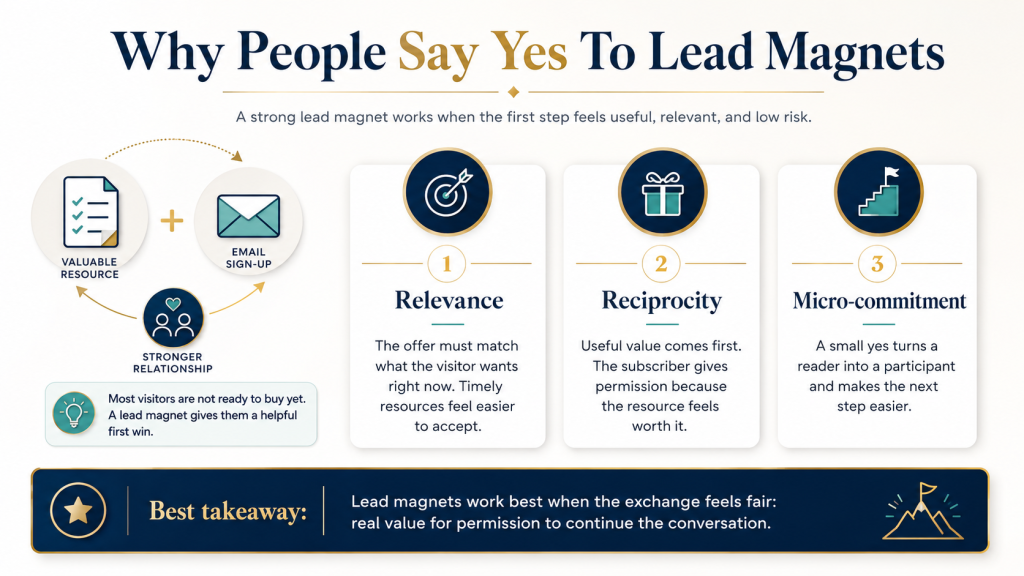
Lead magnets work because they make the first step feel useful and low risk.
Most visitors are not ready to buy the first time they find you. They may be comparing options, trying to understand a problem, or looking for a small answer before they trust a larger solution.
A lead magnet gives them that first answer.
The exchange works when the visitor believes the resource is worth the information requested. An email address may feel like a fair trade for a helpful checklist, template, quiz result, report, or training. It feels less fair when the offer is vague or the form asks for more than the resource justifies.
Three forces make a strong lead magnet effective.
Relevance
A lead magnet must match what the visitor cares about in that moment.
Someone reading about landing page optimization is more likely to want a landing page checklist than a general marketing ebook. Someone comparing email platforms may want a decision guide, not a beginner’s introduction to email marketing.
Relevance makes the offer feel timely.
The reader sees the lead magnet and understands why it belongs there.
Reciprocity
A useful lead magnet creates a small but meaningful exchange.
The business gives practical value first. The visitor responds by giving permission to continue the conversation.
This does not mean the subscriber owes the business a purchase. It means the relationship starts with usefulness instead of pressure.
That first impression matters.
If the lead magnet solves a real problem, the subscriber is more likely to trust the next email, resource, or offer.
Micro-Commitment
Downloading a lead magnet is a small action.
But it is still action.
The visitor moves from passive reader to participant. They have identified a problem, accepted help, and taken a step into your audience.
That small commitment can make future engagement easier when the follow-up remains relevant.
The lead magnet opens the door. The nurture sequence determines whether the relationship continues.
A lead magnet works best when it creates a fair exchange: the visitor receives a useful result, and the business earns permission to keep helping.
The Real Job Of A Lead Magnet
The real job of a lead magnet is not to collect as many email addresses as possible.
It is to attract the right people and move them into the right next step.
That distinction matters.
A broad giveaway can grow a list quickly, but it may fill the list with people who only wanted the free resource. Those subscribers may never open future emails, consider your offer, or become customers.
A focused lead magnet may attract fewer people, but the people it attracts are more likely to care about the problem your business solves.
That is usually more valuable.
A strong lead magnet should do four jobs.
| Job | What It Means |
|---|---|
| Attract | Bring in people with a relevant problem |
| Prove | Show that your business can help before asking for a sale |
| Segment | Reveal what the person needs, wants, or cares about |
| Advance | Move the subscriber toward the next logical step |
For example, a landing page checklist does more than collect an email address.
It attracts people trying to improve conversions. It proves your ability to simplify the process. It may reveal interest in conversion optimization. It can lead naturally to a landing page audit, optimization service, or related email sequence.
That is what makes it strategic.
The lead magnet is not the end point. It is the entry point.
It should create enough value to earn trust and enough relevance to make the next step feel obvious.
The Lead Magnet Fit Test
A lead magnet should be tested before it is created.
The question is not whether the format sounds useful. The question is whether the offer fits the audience, the problem, and the next step.
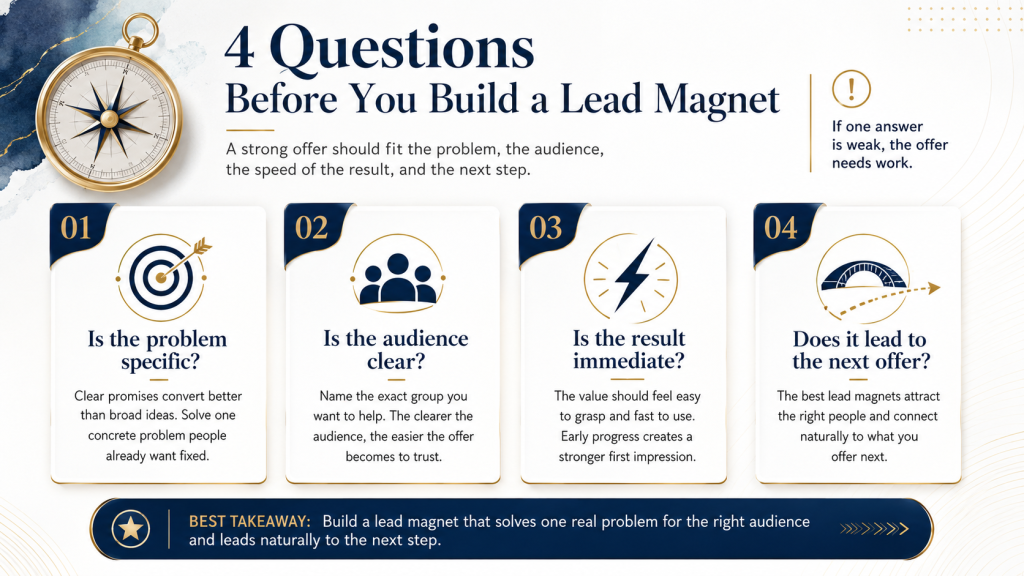
Use this four-part test before building one.
1. Is The Problem Specific?
A strong lead magnet solves one clear problem.
Weak promise:
“Improve your marketing.”
Stronger promise:
“Write a five-email welcome sequence for new subscribers.”
The stronger promise is easier to understand. It tells the reader what they will accomplish and makes the value easier to judge.
Specific problems convert better because they feel closer to action.
2. Is The Audience Clear?
A lead magnet for everyone usually feels useful to no one.
The audience should be easy to name.
For example:
- New coaches building their first email list
- SaaS teams trying to improve trial activation
- E-commerce brands choosing a product quiz
- B2B marketers creating sales enablement content
- Freelancers building a proposal system
The clearer the audience, the easier it becomes to choose the right promise, format, examples, and follow-up.
3. Is The Result Immediate?
The reader should understand the value quickly.
That does not mean every lead magnet must be short. It means the useful part should not be buried.
A one-page checklist can work because the value appears immediately.
A longer guide can also work if it is structured clearly and helps the reader find the answer without effort.
The faster the reader experiences progress, the stronger the first impression.
4. Does It Connect To The Next Offer?
A lead magnet should lead naturally to what comes after it.
- A budgeting worksheet can lead to financial planning services.
- A landing page checklist can lead to a landing page audit.
- A product quiz can lead to a recommended product category.
- A free trial can lead to product activation and paid conversion.
If the lead magnet attracts people who do not need your next offer, it may grow the list while weakening the business result.
The best lead magnet sits close to the problem your business solves.
The Most Effective Types Of Lead Magnets
There is no single best lead magnet format.
The best format depends on what the audience needs to do next.
A person who needs a quick process may want a checklist. A person comparing options may need a buyer’s guide. A person looking for a personalized answer may respond better to a quiz, calculator, or assessment.
The format should match the task.
Quick-Win Lead Magnets
Quick-win lead magnets help the reader take action immediately.
They work well when the audience understands the problem and wants a practical next step.
Common examples include:
- Checklists
- Cheat sheets
- Templates
- Worksheets
- Swipe files
- Short planners
These formats work because they reduce effort.
A checklist gives the reader steps to follow. A template removes the blank page. A cheat sheet condenses useful information into a fast reference. A swipe file gives examples the reader can study or adapt.
Use this type when the reader wants progress more than explanation.
Educational Lead Magnets
Educational lead magnets help the reader understand a topic more clearly.
They work well when the problem is complex, unfamiliar, technical, or high stakes.
Common examples include:
- Guides
- Mini ebooks
- White papers
- Reports
- Glossaries
- FAQ resources
These formats are useful when the reader needs context before taking action.
The risk is overloading the reader. A long resource should still be focused. It should explain one topic clearly rather than trying to become a complete library.
Use this type when the reader needs clarity before they can move forward.
Decision-Support Lead Magnets
Decision-support lead magnets help the reader compare options or justify a next step.
They work well when the audience is evaluating a purchase, strategy, vendor, or method.
Common examples include:
- Case studies
- Comparison charts
- Buyer’s guides
- Decision trees
- Benchmark reports
- ROI calculators
These formats help the reader reduce uncertainty.
A case study shows proof. A comparison chart organizes tradeoffs. A benchmark report shows how the reader compares against a standard. A calculator can help estimate value or cost.
Use this type when the reader is moving from interest to evaluation.
Interactive Lead Magnets
Interactive lead magnets produce a result based on the user’s input.
They work well when the answer should change from person to person.
Common examples include:
- Quizzes
- Calculators
- Assessments
- Scorecards
- Product finders
- Recommendation tools
These formats can create strong relevance because the user participates in the experience.
A quiz can recommend a product. A calculator can estimate savings. An assessment can diagnose readiness. A scorecard can show performance gaps.
Use this type when personalization makes the result more useful.
Experience-Based Lead Magnets
Experience-based lead magnets create value through guided participation over time.
They work well when trust requires explanation, repetition, demonstration, or product experience.
Common examples include:
- Email courses
- Mini courses
- Webinars
- Video trainings
- Challenges
- Free trials
These formats usually require more commitment from the audience, but they can create deeper engagement.
A webinar gives room for teaching. A mini course builds understanding through sequence. A challenge creates momentum. A free trial lets the product demonstrate value directly.
Use this type when the audience needs more than a download to believe, learn, or act.
The strongest format is the one that matches the user’s next step with the least necessary friction.
How To Choose The Right Lead Magnet Format
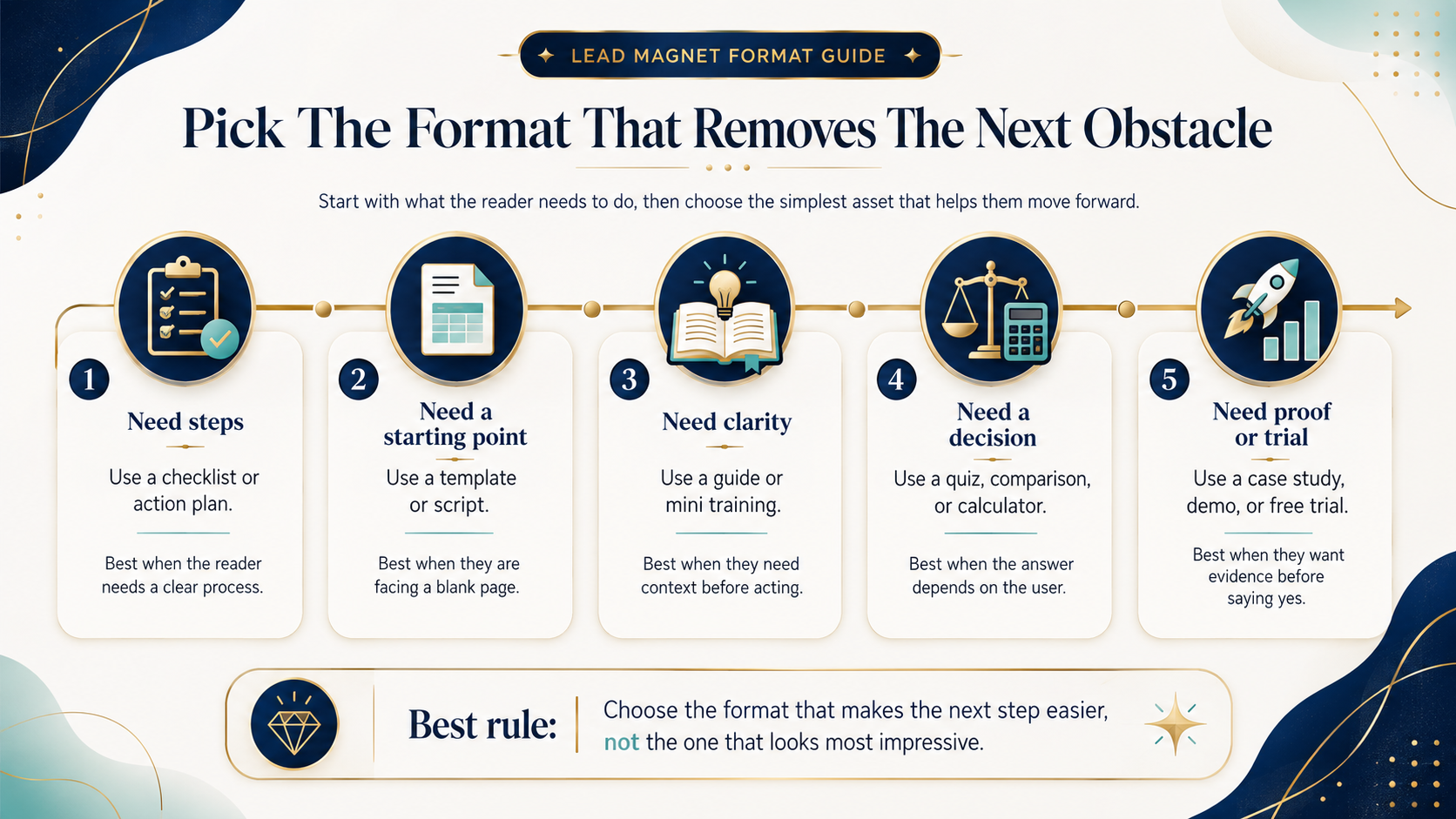
The best lead magnet format depends on what the reader is trying to do.
Start with the user’s task, not the asset type.
The format should make the promised outcome easier to reach.
If the reader already understands the problem, they usually need something practical. A checklist, template, script, worksheet, or action plan can help them move from intention to execution.
If the reader is still trying to understand the problem, they need more context. A guide, white paper, report, or mini course can help them make sense of the topic before they act.
If the reader is comparing choices, they need decision support. A buyer’s guide, comparison chart, case study, calculator, or benchmark can help them evaluate tradeoffs with more confidence.
If the answer depends on personal context, an interactive format becomes more useful. A quiz, assessment, product finder, or calculator can adapt the result to the user instead of giving everyone the same resource.
The key is to avoid adding complexity where it does not create value.
A quiz is not better than a checklist if the answer is obvious. A webinar is not better than a template if the reader only needs a starting point. A long guide is not better than a one-page worksheet if the reader wants to act now.
The best format removes the next obstacle in the reader’s path.
How To Create A High-Converting Lead Magnet
A high-converting lead magnet starts with strategy.
Design comes later.
The goal is to create something your audience already wants, then package it in a way that feels easy to understand, easy to use, and worth exchanging an email address for.
1. Find The Problem Worth Solving
Start with evidence from the audience.
Look at:
- Search queries.
- Sales questions.
- Customer support tickets.
- Blog comments.
- Community discussions.
- Survey responses.
- Popular content.
- Objections during sales calls.
The goal is to identify a problem people already care about.
Do not begin with the resource you want to make. Begin with the problem your audience has a reason to solve.
A lead magnet created from real audience demand will usually be stronger than one created from internal assumptions.
2. Define One Clear Promise
A lead magnet should make one promise.
Weak promise:
“Improve your marketing.”
Stronger promise:
“Plan your next 30 days of content in one worksheet.”
The stronger promise is narrow. That makes it easier to understand and easier to fulfill.
Broad promises create hesitation because the reader cannot quickly see what they will receive.
Specific promises create confidence because the outcome is visible before the opt-in.
3. Match The Format To The Promise
The format should help deliver the promised result with the least necessary friction.
- A checklist works when the promise is completion.
- A template works when the promise is structure.
- A calculator works when the promise is an estimate.
- A quiz works when the promise is a recommendation.
- A guide works when the promise is understanding.
The format should not make the user work harder than the result requires.
4. Build For Immediate Usefulness
The lead magnet should create value without requiring a sales call.
A good resource should help the subscriber think:
“This is clear. This helped. This brand understands the problem.”
That response matters because the lead magnet is often the first real experience someone has with your business.
Useful does not mean exhaustive.
A one-page checklist that helps someone act today may be more valuable than a long ebook they never open.
5. Make The Landing Page Specific
The landing page should explain the value exchange quickly.
It should answer:
- Who is this for?
- What problem does it solve?
- What will the person receive?
- How long will it take to use?
- What information is required?
The page does not need to explain everything.
It needs to make the promise clear enough for the right person to say yes.
6. Deliver The Resource Immediately
Delivery is part of the trust-building process.
After someone opts in, the next step should be obvious.
The confirmation page should make clear what happens next. The email should arrive quickly. The resource should be easy to access.
A delayed, broken, or confusing delivery experience weakens trust at the exact moment the relationship begins.
7. Follow Up With Context
The first follow-up should connect directly to the lead magnet.
Do not move immediately into a generic pitch.
A useful follow-up might include:
- A short explanation of how to use the resource.
- A common mistake to avoid.
- A related example.
- A next-step checklist.
- A short story showing the resource in action.
- A relevant offer when the timing is right.
The lead magnet starts the relationship.
The follow-up develops it.

The Simple Lead Magnet Stack
A lead magnet does not need a complicated marketing system to work.
It needs four basic pieces:
| Part | Purpose |
|---|---|
| Creation Tool | Builds the resource |
| Opt-In Page Or Form | Captures the subscriber |
| Email Platform | Delivers the resource and sends follow-up |
| Analytics Tool | Measures traffic, opt-ins, and engagement |
Most creators and small businesses overbuild too early.
They spend too much time comparing software, designing automation maps, or connecting advanced tools before they have proven that the offer is worth wanting.
Start simple.
A useful checklist delivered through an email platform can outperform a complex funnel built around a weak offer.
The stack should match the maturity of the lead magnet.
For a first lead magnet, you may only need:
- A simple PDF, template, or worksheet.
- A landing page or embedded form.
- An email platform to deliver the resource.
- Basic tracking to measure visits and opt-ins.
As the lead magnet proves itself, the system can become more sophisticated.
You might add:
- CRM tagging.
- Audience segmentation.
- Automated nurture sequences.
- Lead scoring.
- Retargeting audiences.
- A/B testing.
- Revenue tracking.
Those additions are useful only when they improve the next step.
Technology should support the value exchange. It should not become the project.
The best stack is the simplest one that lets you create the resource, deliver it reliably, follow up with context, and measure whether the right people are responding.
How To Gate A Lead Magnet Without Hurting Trust
Gating means asking for information before giving access to the resource.
The issue is not whether gating is good or bad.
The issue is whether the value exchange feels fair.
A visitor is more likely to share an email address when the offer is specific, useful, and clearly explained. They are less likely to trust the exchange when the form asks for too much information before proving the value of the resource.
The gate should match the weight of the offer.
Use A Light Gate For Simple Resources
A simple resource should usually have a simple form.
For a checklist, cheat sheet, short template, or worksheet, an email address may be enough.
These assets promise quick value. Asking for phone number, budget, company size, and timeline can make the exchange feel unbalanced.
The more fields you add, the more the visitor starts to wonder whether the resource is really for them or for your sales team.
Use A Stronger Gate For Higher-Value Offers
Some lead magnets can justify more information.
Examples include:
- Custom assessments.
- Benchmark reports.
- Free trials.
- ROI calculators.
- Consultations.
- Detailed audits.
- Product demos.
In these cases, extra questions may improve the experience.
Company size may change the benchmark. Industry may change the recommendation. Current revenue may affect the calculation. Role may help personalize the follow-up.
The key is that each question should either improve the result or make the next step more relevant.
If a question only helps the business and does nothing for the user, it should be used carefully.
Consider Partial Gating
Not every lead magnet has to be fully locked.
A partial gate gives the visitor some value before asking for contact information.
For example:
- A calculator can show a basic estimate, then offer a detailed report by email.
- A quiz can show the result category, then offer a personalized action plan.
- A guide landing page can explain the framework, then offer the downloadable worksheet.
- A benchmark tool can show a general comparison, then send a deeper breakdown.
This approach builds trust before the form appears.
The visitor gets proof that the resource is useful, and the email request feels like the next step rather than a barrier.
Keep The Landing Page Useful
Even when the resource is gated, the public page should still provide enough context to help the reader decide.
A strong landing page explains:
- Who the resource is for.
- What problem it solves.
- What the person will receive.
- What is inside the resource.
- Why the resource is worth the exchange.
- How the information provided will be used.
Do not hide all value behind the form.
A thin landing page gives both readers and search engines very little to understand. Google’s SEO starter guide emphasizes helping search engines understand content and helping users decide whether a page is useful from search results. Google also provides structured data guidance for subscription and paywalled content when parts of a page require access controls.
Make The Exchange Clear
The form should not feel like a trick.
Tell people what they will receive and what happens after they submit.
For example:
- “Get the checklist by email.”
- “Receive your personalized report.”
- “We’ll send the template and one short follow-up lesson.”
- “Your results will be used to personalize the recommendation.”
Clarity reduces hesitation.
A good gate does not pressure the visitor. It explains the exchange plainly and lets the value of the offer do the work.
How To Promote A Lead Magnet
A lead magnet needs distribution.
Publishing it once and waiting for subscribers is not enough. The offer has to appear where the right people are already thinking about the problem it solves.
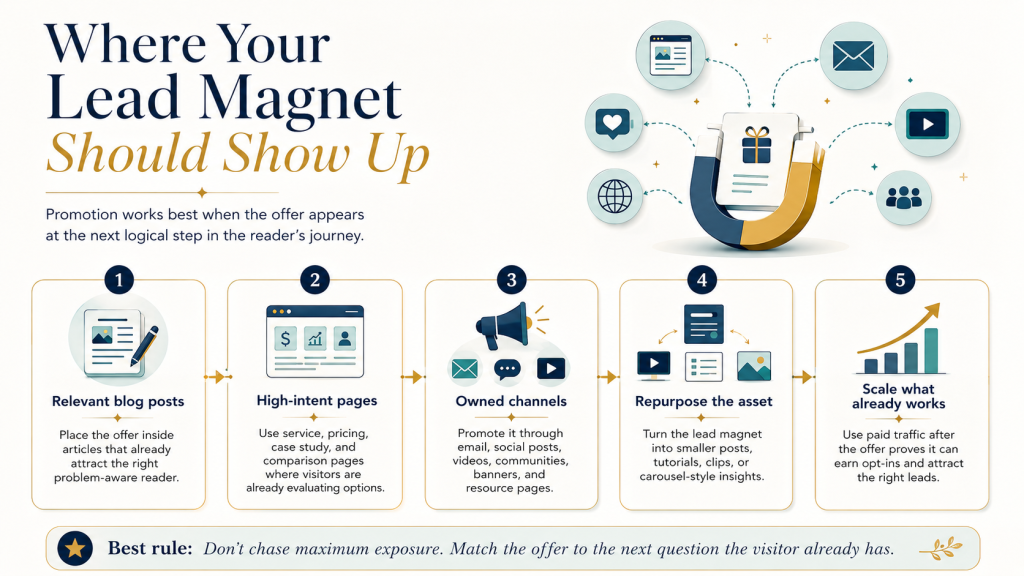
The best promotion does not feel random. It places the lead magnet at the next logical step in the reader’s journey.
Add It To Relevant Blog Posts
Start with content that already attracts related traffic.
A landing page checklist belongs inside articles about landing page optimization, paid traffic, conversion rates, or form design.
An email sequence template belongs inside articles about welcome emails, lead nurturing, opt-in forms, or newsletter growth.
The offer should feel like a continuation of the article, not an interruption.
When the topic match is strong, the lead magnet becomes a helpful next step.
Use High-Intent Website Pages
Some pages attract visitors who are already evaluating your business.
These may include:
- Product pages.
- Service pages.
- Pricing pages.
- Comparison pages.
- Case studies.
- Resource hubs.
- Consultation pages.
A lead magnet on these pages should support the decision the visitor is already considering.
For example, a pricing page may pair well with an ROI calculator. A case study page may pair well with a related implementation checklist. A service page may pair well with an audit or assessment.
The closer the lead magnet is to the visitor’s intent, the stronger the offer feels.
Promote It Through Owned Channels
Use the channels you already control.
These may include:
- Email newsletters.
- Social media profiles.
- YouTube descriptions.
- Podcast show notes.
- Email signatures.
- Community posts.
- Website banners.
- Resource pages.
The message should change by channel.
A social post may focus on the problem. A newsletter may explain why the resource was created. A YouTube description may position it as the next step after the video.
Do not simply announce the lead magnet. Show why it helps.
Repurpose The Lead Magnet Into Smaller Content
A good lead magnet contains several smaller ideas.
Those ideas can become promotional content.
- A checklist can become a carousel post.
- A template can become a short tutorial.
- A report can become charts, insights, or commentary.
- A webinar can become clips, quotes, or email lessons.
- A quiz can become posts about the different result types.
Repurposing works because it gives value before asking for the opt-in. The audience sees part of the usefulness first, which makes the full resource more attractive.
Use Paid Traffic After The Offer Is Proven
Paid traffic can amplify a strong lead magnet.
It can also make a weak offer expensive.
Before spending heavily, confirm that:
- The landing page gets opt-ins.
- The delivery works.
- The follow-up sequence receives engagement.
- The leads are relevant.
- The offer connects to a business outcome.
Paid promotion should scale evidence, not replace it.
Start with organic placement and owned channels. Use paid traffic when you know the offer earns attention from the right audience.
Keep Promotion Contextual
The same lead magnet does not belong everywhere.
A visitor reading a beginner guide may need a checklist. A visitor comparing tools may need a buyer’s guide. A visitor on a pricing page may need a calculator or case study.
Promotion works best when the offer answers the next question in the reader’s mind.
The goal is not maximum exposure.
The goal is relevant exposure.
How To Measure Lead Magnet Performance
Opt-ins matter, but they do not tell the full story.
A lead magnet can generate many subscribers and still fail if those subscribers never open your emails, never engage with your offer, or never become qualified opportunities.
Measurement should follow the whole path from visitor to business result.
Measure Traffic Quality
Start by looking at who reaches the lead magnet.
Track:
- Landing page visits.
- Traffic source.
- New versus returning visitors.
- Device type.
- Cost per visitor.
Traffic volume alone is not enough.
A small number of highly relevant visitors may produce better results than a large amount of weak traffic. The goal is not just to get people to the page. The goal is to get the right people to the page.
Measure The Opt-In
The opt-in rate shows whether the value exchange is clear enough.
Track:
- Form views.
- Form starts.
- Form completions.
- Opt-in rate.
- Cost per lead.
Use a clear formula:
Opt-In Rate = Leads ÷ Landing Page Visitors × 100
If many people visit the page but few subscribe, the problem may be the offer, headline, page copy, form length, traffic source, or perceived value.
Measure Delivery And Engagement
A lead is not useful if the relationship stops after the form submission.
Track:
- Confirmation email open rate.
- Delivery email click rate.
- Download or access rate.
- Follow-up email engagement.
- Unsubscribe rate.
- Reply rate, when relevant.
These metrics show whether the subscriber still cares after opting in.
If many people subscribe but few access the resource, the delivery experience may be unclear or the original promise may have attracted low-intent leads.
Measure Lead Quality
Lead quality shows whether the lead magnet is attracting the right audience.
Track:
- Ideal customer profile fit.
- Marketing-qualified lead rate.
- Sales-qualified lead rate.
- Sales acceptance rate.
- Disqualification reasons.
- Meeting-booking rate.
A broad giveaway may produce a high opt-in rate and a weak qualified lead rate.
A more focused lead magnet may generate fewer subscribers but better-fit leads.
That second result is often more valuable.
Measure Business Outcomes
The final test is whether the lead magnet contributes to the business.
Track:
- Opportunity rate.
- Pipeline generated.
- Customer conversion rate.
- Revenue per lead.
- Cost per qualified lead.
- Payback on production cost.
These metrics connect the asset to actual business value.
A lead magnet should not be judged only by how many emails it collects. It should be judged by whether it attracts people who continue engaging and eventually move toward the next meaningful step.
Diagnose The Funnel
Each metric helps identify a different problem.
| Pattern | Likely Issue |
|---|---|
| High traffic, low opt-in rate | Weak offer, poor page copy, or wrong traffic |
| High opt-in rate, low email engagement | Offer attracted curiosity but not real intent |
| Strong engagement, low qualification | Topic is useful but not close enough to the business offer |
| Strong qualification, low meetings | Follow-up or call to action may be weak |
| High lead volume, low revenue | Lead magnet may be attracting the wrong segment |
The strongest lead magnet is not always the one with the highest opt-in rate.
It is the one that creates the most relevant progress from visitor to subscriber to qualified opportunity.

Common Lead Magnet Mistakes
Most lead magnets fail for practical reasons.
The idea may be useful, but the offer is too broad, the format is wrong, the promise is unclear, or the follow-up is disconnected.
A strong lead magnet should feel intentional from the first click to the first follow-up email.
The Promise Is Too Broad
Broad promises are easy to write and hard to believe.
“Grow your business” does not tell the reader what they will receive.
“Plan your next 30 days of content in one worksheet” is more useful because the outcome is specific.
A lead magnet should make one clear promise. The reader should know what problem it solves before they submit their email address.
The Audience Is Too Vague
A lead magnet for everyone usually attracts weak-fit subscribers.
The best offers are built for a clear audience with a clear problem.
A landing page checklist for SaaS demo pages is stronger than a generic conversion checklist if the business serves SaaS companies. A proposal template for freelance designers is stronger than a general business proposal template if the audience is designers.
Specificity may reduce total opt-ins, but it usually improves relevance.
The Format Does Not Match The Problem
The format should make the result easier to reach.
A webinar may be unnecessary when the reader only needs a short checklist. A checklist may be too thin when the reader needs deep explanation. A quiz may feel forced when the answer is the same for everyone.
Do not choose a format because it is popular.
Choose it because it helps the reader make progress with less friction.
The Resource Takes Too Long To Use
Long resources are not automatically bad.
They become a problem when the reader cannot find value quickly.
A detailed guide can work if it is clearly structured. A long ebook fails when the useful answer is buried under background information.
Give the reader an early win.
The first few minutes should confirm that the resource was worth the exchange.
The Lead Magnet Is Disconnected From The Offer
A lead magnet can attract subscribers who never become customers if the topic sits too far from the paid offer.
For example, a business selling email marketing software may collect many emails with a general productivity planner. But those subscribers may not care about email marketing.
A welcome sequence template, automation checklist, or subject line cheat sheet would attract a more relevant audience.
The lead magnet should live near the problem your business solves.
The Follow-Up Is Generic
The lead magnet starts the relationship, but the follow-up develops it.
If every subscriber receives the same generic pitch, the business loses the context created by the opt-in.
A person who downloads a beginner checklist needs different follow-up from someone who completes a pricing calculator or requests a benchmark report.
The next email should help the subscriber use the resource, avoid a common mistake, or take the next logical step.
The Delivery Experience Is Sloppy
The moment after the opt-in is part of the promise.
Broken links, delayed emails, confusing confirmation pages, and unclear instructions weaken trust immediately.
The subscriber should know what happens next.
The resource should arrive quickly, open easily, and match what the landing page promised.
The Lead Magnet Is Never Updated
A lead magnet can become outdated quietly.
Software screenshots change. Data gets old. Tools disappear. Examples lose relevance. Recommendations stop matching current best practices.
Review the resource regularly.
An outdated lead magnet signals neglect, especially if it is the first real experience someone has with your brand.
The Email Program Ignores Compliance
Lead magnets usually begin an email relationship.
That means the email program should be clear, honest, and easy to leave.
Commercial emails should avoid misleading sender information and subject lines. They should also include a valid physical mailing address and a clear way to opt out.
The FTC’s CAN-SPAM guidance explains these requirements for commercial email in the United States.
How Often Should You Update A Lead Magnet?
A lead magnet should be updated whenever it can no longer keep the promise made on the landing page.
Some resources age slowly.
A basic checklist, worksheet, or strategy framework may stay useful for a long time if the process remains accurate.
Other resources need more frequent attention.
Examples include:
- Tool comparisons
- Software tutorials
- AI prompt libraries
- Legal or compliance guides
- Benchmark reports
- Pricing calculators
- Platform-specific templates
- Industry trend reports
These assets depend on information that can change quickly.
A software screenshot may become outdated. A recommended tool may change its pricing. A benchmark may stop reflecting current conditions. A compliance guide may need revision after a rule changes.
The risk is not only factual inaccuracy.
An outdated lead magnet can weaken trust because it is often one of the first resources a subscriber receives from the brand.
A practical review cycle is every six to twelve months.
That does not always mean a full rewrite.
A useful update may include:
- Replacing outdated examples.
- Checking links.
- Updating screenshots.
- Refreshing data.
- Removing obsolete tools.
- Clarifying instructions.
- Improving design.
- Tightening the landing page promise.
- Updating the follow-up sequence.
The lead magnet should also be reviewed when performance changes.
A sudden drop in opt-ins may suggest the promise has lost relevance. Lower email engagement may mean the resource no longer matches subscriber expectations. Poor lead quality may mean the offer is attracting the wrong audience.
Updating a lead magnet is not about keeping it new for its own sake.
It is about keeping the value exchange honest.
Conclusion
A lead magnet is more than a free resource.
It is the first proof that your business can help.
The best lead magnets solve one clear problem for one specific audience. They deliver value quickly, connect naturally to the next step, and make the subscriber feel that the exchange was worth it.
That trust is the real asset.
An email address has little value if the person behind it is not interested, qualified, or engaged. A smaller list of people who care about the problem you solve is more useful than a large list built from vague giveaways.
Start with the audience.
Find the problem they already want to solve.
Make one specific promise.
Choose the simplest format that delivers the result.
Then measure what happens after the opt-in.
A strong lead magnet does not just grow your email list. It creates a useful beginning to a relationship that can continue.

Frequently Asked Questions
What Is A Lead Magnet?
A lead magnet is a useful offer given in exchange for contact information, usually an email address.
Examples include checklists, templates, guides, quizzes, calculators, webinars, reports, free trials, and email courses.
What Makes A Good Lead Magnet?
A good lead magnet solves one specific problem for one specific audience.
It should be easy to understand, fast to use, relevant to the reader’s current need, and connected to the next step your business wants to offer.
What Is The Best Lead Magnet Format?
There is no universal best format.
The best format depends on what the reader needs to do. A checklist works well for steps. A template works well for structure. A guide works well for explanation. A quiz or calculator works well when the answer should be personalized.
How Long Should A Lead Magnet Be?
A lead magnet should be long enough to solve the promised problem and short enough to use without unnecessary effort.
A one-page checklist can be stronger than a long ebook when the reader needs action. A longer guide can work when the topic requires depth, but the value should still be easy to find.
Should A Lead Magnet Be Gated?
A lead magnet can be gated when the value justifies the exchange.
Simple resources usually need only a short form. Higher-value resources such as assessments, benchmark reports, calculators, or free trials may justify more information when that information improves the result or follow-up.
Can A Gated Lead Magnet Rank In Search?
The public landing page can rank if it provides enough useful context for readers and search engines.
The downloadable resource may be gated, but the page promoting it should clearly explain the topic, audience, value, and contents of the offer.
How Do You Measure Lead Magnet Success?
Measure opt-ins, but do not stop there.
Track email engagement, qualified lead rate, meeting bookings, opportunity creation, revenue, and unsubscribe behavior. A lead magnet that attracts fewer but better-qualified leads may be more valuable than one with a higher opt-in rate.
How Many Lead Magnets Should A Business Have?
Start with one strong lead magnet tied to your most important audience and offer.
After it performs consistently, create additional lead magnets for different problems, traffic sources, funnel stages, or buyer segments.
How Often Should A Lead Magnet Be Updated?
Review most lead magnets every six to twelve months.
Update sooner if the resource includes software screenshots, pricing, benchmarks, compliance information, AI tools, or platform-specific instructions.
What Is The Biggest Lead Magnet Mistake?
The biggest mistake is creating something the business wants to give away instead of something the audience actually wants.
A strong lead magnet starts with audience demand, not internal convenience.
Pingback: Lead Magnet Software: Grow Your Email List Faster - Lead Magnets Creator
Pingback: How to Use Swipe Files to Grow Your Email List Fast - Lead Magnets Creator
Pingback: Lead Magnets for Affiliate Marketing: How to Boost Conversions - Lead Magnets Creator
Pingback: AI-Powered Lead Magnets That Actually Convert - Lead Magnets Creator
Pingback: Interactive Lead Magnets: How They Work and Why They Convert - Lead Magnets Creator
Pingback: Checklist Lead Magnet Ideas That Build Your List - Lead Magnets Creator