Introduction
A swipe file can be a valuable source of ideas or a cluttered folder you never use. The difference is thoughtful curation.
A swipe file lead magnet is an organized collection of emails, headlines, ads, landing pages, or other examples offered in exchange for an email address. Unlike a private swipe file, it is created for others, so the examples should be sourced responsibly and explained clearly.
The goal is not to encourage copying. It is to help subscribers recognize useful patterns, understand why an example stands out, and adapt the underlying idea to their own audience.
This guide will show you how to create a focused swipe file lead magnet that informs, inspires, and respects the original work.
Key Takeaways
- A compelling swipe file solves one specific creative problem for a clearly defined audience.
- Carefully selected examples are more desirable than a large, unfocused collection.
- Original commentary, comparisons, and prompts give readers a reason to save and revisit the resource.
- Third-party work should be sourced responsibly; attribution alone does not automatically grant permission to reproduce it.
- The best format is the one that makes examples easy to explore, compare, and apply.
- A swipe file can attract relevant subscribers when its promise connects naturally to your expertise and next offer.
Affiliate Disclosure: Some of the links on this site are affiliate links. That means if you click and make a purchase, I may earn a small commission at no extra cost to you.
What Is a Swipe File?
A swipe file is a collection of examples saved for study, inspiration, and future reference.
Writers, marketers, designers, and business owners often use swipe files to examine how other creators structure ideas, present offers, open messages, or guide readers toward action.
The purpose is not to copy someone else’s work. It is to notice useful patterns, understand the choices behind an example, and apply the underlying lesson in an original way.
What a Swipe File May Contain
A swipe file can include many types of creative or marketing material, such as:
- Email subject lines
- Email introductions
- Headlines
- Advertisements
- Landing pages
- Calls to action
- Social media hooks
- Offer descriptions
- Sales-page sections
- Layout or design examples
The strongest collections usually focus on one topic or outcome. A swipe file containing welcome emails for online coaches will be easier to understand and use than a general folder filled with unrelated marketing examples.
Swipe Files vs. Templates
Swipe files and templates serve different purposes.
A swipe file gives readers examples to study. It helps them notice patterns in the structure, tone, positioning, or presentation.
A template gives them a framework to complete or adapt.
For example, a swipe file may show ten welcome emails and explain how each one introduces the sender, sets expectations, or encourages a reply. A welcome email template would provide a structure the reader can fill in with their own information.
Both resources can work together, but examples should teach adaptation rather than invite word-for-word copying.
Private Swipe Files vs. Swipe File Lead Magnets
A private swipe file is a personal research library. You may save examples to study privately while improving your own writing, design, or marketing skills.
A swipe file lead magnet is different because it is distributed to subscribers in exchange for their email addresses.
Public distribution requires more care. You need to consider where each example came from, whether you have permission to reproduce it, how much of the original work is necessary, and whether linking to the source would be more appropriate than including the full example.
Attribution is helpful, but credit alone does not automatically grant permission to redistribute someone else’s work. When possible, use your own material, request permission, include licensed examples, quote only what is necessary for genuine commentary, or recreate the principle through an original example.
Why Swipe Files Work Well as Lead Magnets
A focused swipe file gives readers something they can study and use immediately. Instead of offering general advice, it shows how ideas appear in real messages, pages, or campaigns.
Its value comes from thoughtful selection and explanation not simply the number of examples included.
Practical Inspiration Without the Blank Page
Many people understand a principle in theory but struggle to apply it when they begin writing or creating.
A swipe file gives them a practical starting point. By reviewing several relevant examples, readers can see different ways to approach a headline, opening, offer, or call to action.
The examples should support original thinking. A useful swipe file helps readers ask:
- What is this example trying to accomplish?
- Which part caught my attention?
- How is the message structured?
- What could I adapt for my own audience?
- Which details depend on the original brand or offer?
These questions turn inspiration into active learning.
Focused Collections Attract More Relevant Subscribers
A narrow swipe file makes it easier for potential subscribers to understand its value.
Compare these offers:
The second title identifies the type of example, the intended audience, and the situation in which the resource may help.
That focus can also improve lead quality. Someone who downloads welcome email examples may reasonably be interested in email strategy, copywriting, course marketing, or related services.
Commentary Adds the Real Teaching Value
An example alone does not explain why it deserves attention.
Brief commentary can show readers what to notice, such as:
- The audience
- The purpose of the message
- The opening approach
- The offer positioning
- The structure
- The call to action
- A possible adaptation lesson
- Important limitations or context
This analysis turns a collection into an educational resource.
For example, rather than displaying a subject line and calling it effective, explain what type of email it introduced, which audience received it, and what element may have made it interesting.
Comparison Helps Readers Recognize Patterns
One example may be memorable, but several well-chosen examples can reveal recurring approaches.
Readers may notice that clear welcome emails often set expectations early, that effective landing pages repeat one central promise, or that strong calls to action describe a specific next step.
However, repeated patterns do not prove that one phrase or design choice caused a result. Performance may also depend on the audience, offer, timing, brand recognition, and surrounding campaign.
A responsible swipe file presents useful observations without claiming certainty that the available evidence does not support.
Easy-to-Use Resources Encourage Return Visits
A swipe file can remain useful after the first download when the examples are clearly organized and easy to revisit.
Readers may return when they need inspiration for another email, advertisement, landing page, or social post. Searchable categories, descriptive labels, and concise commentary make that repeated use easier.
Subtle branding and a relevant link can also help readers reconnect with your business when they need deeper support.
A swipe file works well as a lead magnet when it combines relevant examples, responsible sourcing, useful commentary, and a clear lesson readers can adapt to their own work.
Where Swipe File Lead Magnets Create the Most Value
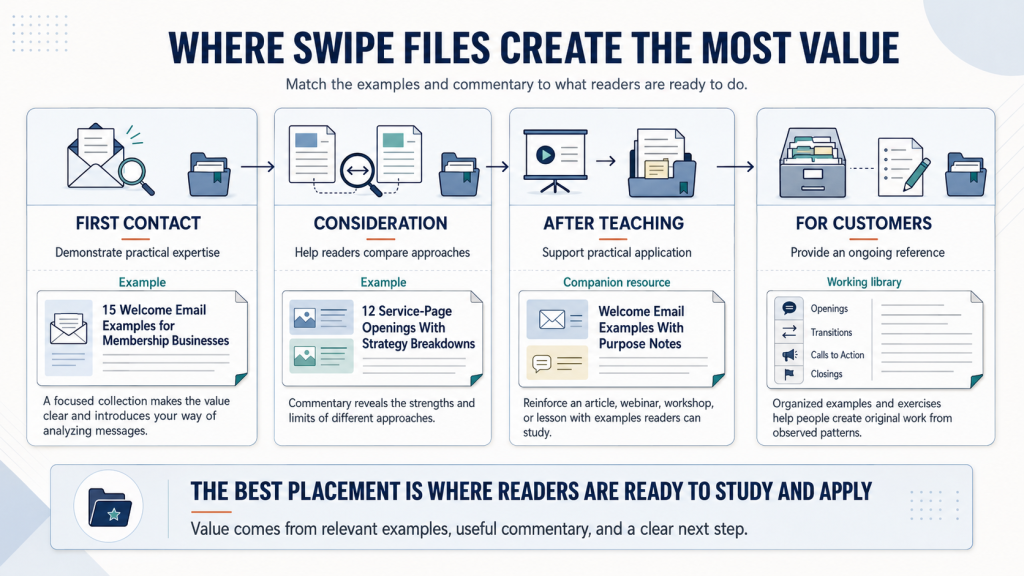
A swipe file can support different stages of the customer journey, but its value depends on the examples included, the commentary provided, and the next step you want readers to take.
At First Contact: Demonstrate Practical Expertise
A focused swipe file can attract new subscribers by showing examples related to a problem they already want to solve.
15 Welcome Email Examples for Membership Businesses
This offer is specific enough for readers to understand immediately. It also introduces them to the way you analyze messaging without claiming that every example produced exceptional results.
During Consideration: Help Readers Compare Approaches
Readers who are already exploring a solution may benefit from seeing how different creators approach the same challenge.
12 Service-Page Openings With Strategy Breakdowns
The examples could compare direct, story-led, problem-focused, and outcome-focused openings. Commentary would help readers understand the strengths and limitations of each approach.
This kind of resource can demonstrate your thinking while helping potential clients make more informed decisions.
After Teaching: Support Practical Application
Swipe files work well as companion resources for articles, webinars, workshops, and course lessons.
A webinar about welcome sequences, for instance, could include a collection of real or original welcome email examples with notes explaining the purpose of each message.
The swipe file should reinforce what the audience has just learned. It should not feel like an unrelated bonus added only to increase perceived value.
For Customers: Provide an Ongoing Reference
Clients, students, and customers may use a more detailed swipe file while applying a service, course, or framework.
A copywriting course could include categorized examples of:
- Email openings
- Transitions
- Calls to action
- Offer descriptions
- Closing sections
Exercises could then guide students to create original versions based on the patterns they observe.
A swipe file’s place in the funnel depends on its focus, depth, and intended use. The best placement is wherever readers are ready to study examples and apply the lessons to a real task.
How to Build a Useful Swipe File Lead Magnet
A strong swipe file is more than a folder of interesting examples. It should help a specific audience study useful patterns, understand the thinking behind them, and create something original.
These six steps will help you build a focused collection that is practical, responsible, and easy to use.
Choose One Audience and Use Case
Start by deciding who the swipe file is for and what they are trying to create or improve.
For example:
The second topic gives the collection a clear purpose. It also makes it easier to decide which examples belong and which ones should be left out.
Ask yourself:
- Who will use this resource?
- What are they trying to create?
- Which part of the process feels difficult?
- What type of example would help them most?
A focused swipe file is easier to promote, easier to organize, and more useful to the reader.
Decide What You Can Responsibly Include
A private swipe file and a public lead magnet are not the same.
Before adding an example, consider whether you have permission to reproduce it and how much of the original material is necessary.
Your collection may include:
- Your own work
- Examples used with permission
- Licensed or public-domain material
- Short excerpts included for genuine commentary
- Links to original sources
- Original examples inspired by a broader pattern
Attribution is important, but credit alone does not automatically give you permission to redistribute someone else’s work.
When in doubt, link to the original, request permission, or recreate the underlying principle with your own example.
Curate Examples With a Clear Lesson
Do not include an example simply because it looks impressive or caught your attention.
Each entry should demonstrate something the reader can study, such as:
- A clear opening
- An unusual structure
- Strong positioning
- A useful transition
- A specific call to action
- A clear offer
- An effective comparison
- A memorable closing
Avoid describing an example as “proven” or “high-converting” unless you have credible performance data.
An example can still be useful without documented results. In that case, describe what makes it interesting rather than claiming that it produced a particular outcome.
Quality matters more than volume. Ten well-explained examples can be more valuable than one hundred screenshots with no context.
Add Context and Analysis
Commentary turns a collection into a teaching resource.
For each example, briefly explain:
- Who it appears to be written for
- What the message is trying to accomplish
- Which part deserves attention
- How the structure works
- What readers can learn from it
- Which details depend on the original brand or situation
What to notice: The email opens with a specific problem, explains the cost of ignoring it, and introduces the offer only after establishing relevance.
Try this: Open your own email with a problem your audience already recognizes, then explain why it matters before presenting the next step.
This teaches the principle without encouraging word-for-word copying.
Organize the Collection for Comparison
Readers should be able to find relevant examples quickly and compare different approaches.
You might organize the swipe file by:
- Content type
- Goal
- Audience
- Channel
- Funnel stage
- Tone
- Structure
- Technique
A welcome email swipe file, for instance, could include sections for introductions, expectation-setting, personal stories, reply prompts, and calls to action.
Use consistent labels for every entry. A simple structure might include:
- Source
- Audience
- Purpose
- What to notice
- Adaptation lesson
Consistency makes the resource easier to scan and helps readers recognize patterns across several examples.
Choose a Format and Test the Experience
Select a format based on how readers need to browse and use the collection.
A PDF may work well for a short, polished collection. Google Docs can support written commentary, while Google Sheets may be better for sortable categories and source information. Notion or Trello can work for larger libraries that need filters, updates, or ongoing additions.
Before publishing, ask someone from the intended audience to use the swipe file without your help.
Check whether they can:
- Find a relevant example quickly
- Understand why it was included
- Identify the lesson
- Apply the idea without copying
- Locate the original source
- Use the resource comfortably on their device
Their questions can reveal unclear labels, weak commentary, missing context, or navigation problems.
A useful swipe file lead magnet does not simply show readers what others created. It helps them understand what to notice, why it matters, and how to develop an original version for their own audience.
What Makes a Swipe File Worth Downloading
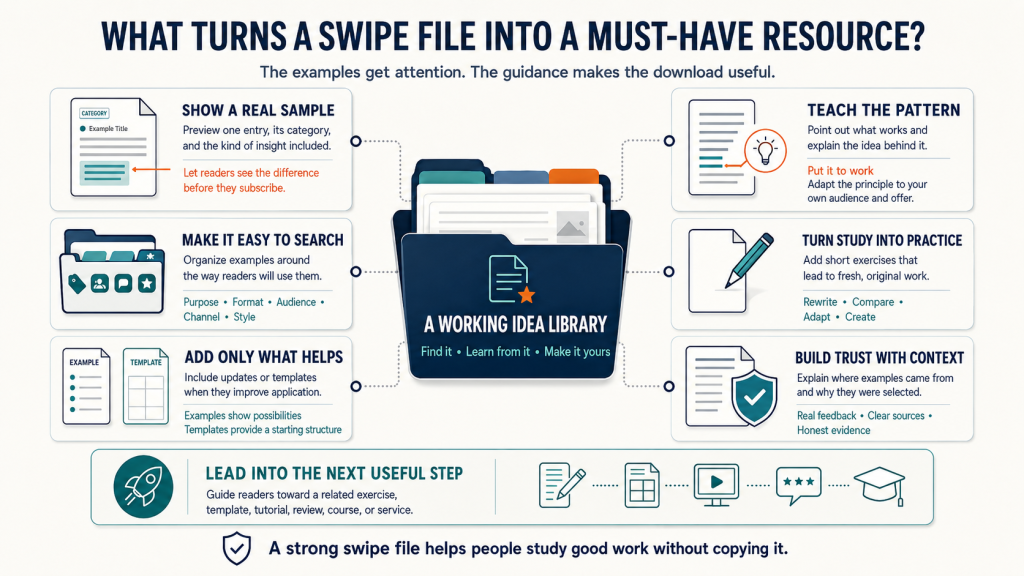
A swipe file becomes more appealing when readers can see that it offers more than a folder of examples.
The real value comes from thoughtful analysis, clear organization, and practical guidance that helps people create original work.
A Clear Preview of the Collection
Show potential subscribers what they will receive before asking for an email address.
You might include:
- A sample entry
- A partial screenshot
- The category list
- A short excerpt
- An example of your commentary
the landing page could preview one email opening along with a short explanation of its structure and purpose.
A useful preview helps readers understand how the resource is different from a basic list of links or screenshots.
Commentary Readers Cannot Get From the Examples Alone
The examples may attract attention, but your analysis gives the collection its teaching value.
Explain what readers should notice, why the example is relevant, and which principle they can adapt.
What to notice: The headline identifies a specific audience and problem before introducing the offer.
Then provide an original application prompt:
Try this: Rewrite your headline so it names who the offer is for and what problem it helps solve.
That added context gives readers something they would not receive by simply viewing the original example.
Searchable or Filterable Organization
A larger collection needs more than section headings.
Categories, tags, filters, or a clickable contents page can help readers locate examples by:
- Goal
- Format
- Audience
- Channel
- Tone
- Funnel stage
- Copy technique
A short PDF may only need clear sections. A growing library may work better in Google Sheets, Notion, or another searchable format.
Choose the simplest organization that helps readers find the right example quickly.
Original Exercises for Applying the Lessons
A swipe file should help readers move from observation to creation.
Short exercises can ask them to:
- Rewrite an opening for their audience
- Create three headline variations
- Compare two calls to action
- Identify the promise in an offer
- Build an original structure from the lesson
These prompts reinforce the principle without encouraging readers to copy the wording.
Updates With a Real Purpose
Ongoing updates can make the resource more valuable when the collection covers changing platforms, trends, or marketing approaches.
However, only promise updates when you genuinely plan to provide them.
A useful update might:
- Replace an outdated example
- Add a new category
- Correct inaccurate commentary
- Include a newly documented result
- Improve the organization
Adding examples only to increase the collection’s size does not necessarily make it better.
A Companion Template When It Helps
A template can help readers apply what they learned from the examples.
a welcome email swipe file might include a separate template showing where to introduce the sender, set expectations, and invite a reply.
Keep the distinction clear:
- The swipe file provides examples to study.
- The template provides a structure to complete.
The companion resource should make application easier rather than distract from the main collection.
Credible Proof and Transparent Context
Proof can strengthen the offer when it is genuine and clearly explained.
You may include:
- Feedback from real users
- Results from your own work
- Documented campaign data
- The number of examples analyzed
- A clear explanation of your selection process
Avoid claims such as “these examples doubled conversions” unless you can verify the result and explain the conditions behind it.
When performance data is unavailable, describe the example as noteworthy, interesting, or instructive instead of proven.
A Relevant Next Step
The swipe file should lead naturally toward further learning or support.
A relevant next step might be:
- A writing exercise
- A related template
- A deeper tutorial
- A copy review
- A course
- A consulting service
The recommendation should help readers continue applying the same lessons.
A swipe file becomes worth downloading when the examples are responsibly sourced, clearly analyzed, easy to explore, and useful enough to inspire original work.
A Simple Setup for Creating and Delivering Your Swipe File
The format should make the swipe file easy to organize, update, and use. Start with the simplest option that fits the size of the collection and the way subscribers will explore it.
| What You Need | Practical Option | Best Fit |
|---|---|---|
| Written examples with detailed commentary | Google Docs | Smaller collections designed to be read in sections |
| Sortable examples and source records | Google Sheets | Swipe files organized by audience, goal, channel, or technique |
| A polished visual download | Canva | Short PDF collections with screenshots, labels, and branded layouts |
| A searchable, evolving library | Notion or Trello | Larger collections that receive updates or contain several categories |
| Signup and automatic delivery | Your existing email platform | Collecting subscribers, delivering access, and sending related follow-up emails |
A PDF may work well for a fixed collection, while a spreadsheet or online library may be better when readers need to filter examples or receive updates.
Whatever format you choose, test it on the devices your audience is likely to use. Make sure examples are readable, links work, categories are clear, and subscribers can access the resource without special software.
Track the Source and Permission Status
Keep a simple record for every example you collect. This helps you maintain accurate attribution, review permissions, and update the resource later.
Record details such as:
- Original creator or company
- Source link
- Date collected
- Permission or licensing status
- Whether the example is reproduced, quoted, or linked
- Your commentary or adaptation lesson
- Documented performance data, when available
Avoid storing results such as open rates, clicks, or conversions without noting where the information came from. When no reliable performance data exists, describe what makes the example useful rather than presenting it as proven.
The best tool is not the one with the most features. It is the one that helps you maintain the collection responsibly and lets subscribers find the right example without unnecessary effort.
Why Some Swipe Files Get Ignored
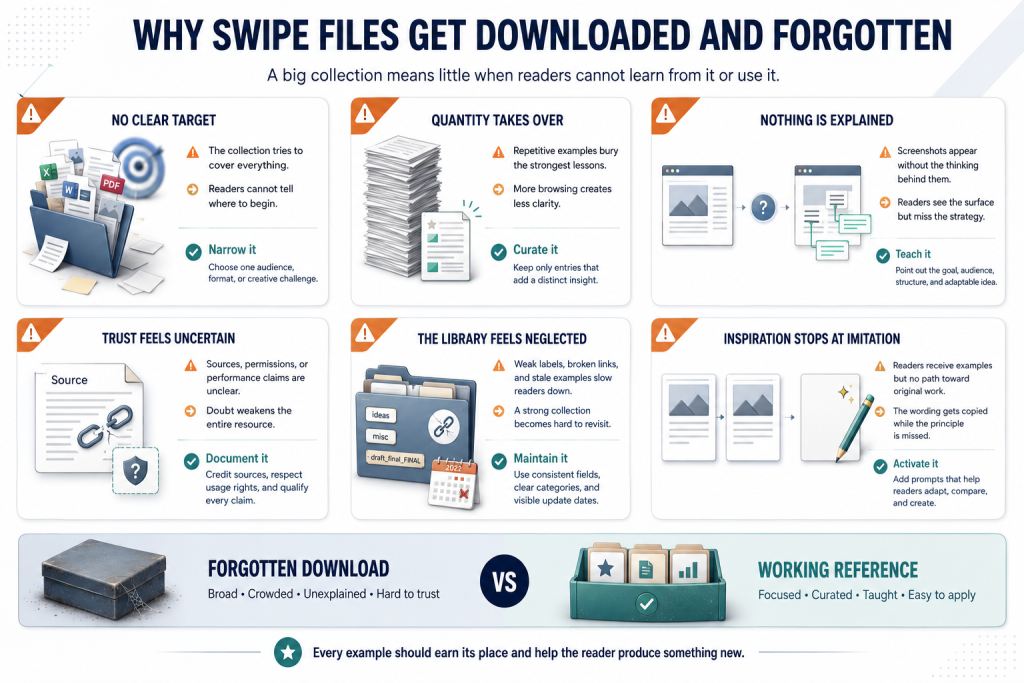
A swipe file may sound valuable on the landing page and still disappoint once subscribers open it.
Broad topics, weak examples, missing context, and poor organization can turn a promising collection into something people skim once and forget. Avoid the following mistakes if you want your swipe file to feel worth downloading, exploring, and returning to.
The Topic Feels Too Broad
A general collection such as “Marketing Inspiration” may contain plenty of examples, but readers will not know where to begin or what the collection will help them create.
A stronger swipe file focuses on one audience, format, or creative challenge.
Compare these offers:
The second offer makes the value easier to recognize. Readers know what the collection contains, who it is for, and what they can learn from it.
Before adding another example, ask whether it supports the swipe file’s central purpose. Interesting material that falls outside that purpose belongs in a different collection.
More Examples, Less Value
A large number on the cover can make a swipe file sound impressive, but quantity can quickly become a burden.
When readers must sort through repetitive, outdated, or loosely related examples, the strongest entries become harder to find. The collection begins to feel like an archive rather than a carefully selected resource.
Review every example and ask:
- Does it demonstrate a distinct lesson?
- Is it relevant to the intended audience?
- Does it strengthen the collection?
- Can I explain why it deserves to be included?
Ten thoughtfully analyzed examples may provide more value than one hundred screenshots with no clear purpose.
Examples With Nothing to Teach
A screenshot or copied headline may catch someone’s attention, but it does not automatically explain what makes the example worth studying.
Readers need help recognizing the decisions beneath the surface.
Brief commentary can explain:
- What the message is trying to accomplish
- Who it appears to target
- Which element deserves attention
- How the structure supports the message
- What readers can adapt
- Which details depend on the original brand or offer
What to notice: The headline identifies the audience, problem, and desired outcome without trying to explain the entire service.
That observation gives readers a lesson they can apply. Without it, the example is simply something to look at.
Unclear Sources and Questionable Rights
Subscribers should be able to tell where an example came from and why it appears in the collection.
Missing links, vague attribution, or uncertain permission can weaken trust. Redistributing someone else’s complete email, advertisement, landing page, or design may also raise copyright or licensing concerns.
Keep a source record for every entry and confirm whether you are:
- Sharing your own work
- Using material with permission
- Including licensed or public-domain content
- Quoting a limited excerpt for commentary
- Linking to the original source
- Demonstrating the principle through an example you created
Credit is important, but attribution alone does not automatically give you permission to redistribute another person’s work.
When the rights are unclear, request permission, reproduce less of the original, link to the source, or create an original example that demonstrates the same broader principle.
Performance Claims Readers Cannot Verify
Words such as “proven,” “winning,” and “high-converting” can make a swipe file sound more desirable. They can also damage credibility when no reliable evidence supports them.
A public advertisement may look persuasive without generating strong results. An engaging subject line may belong to a campaign with poor sales. Even verified performance may depend on factors beyond the copy itself, including:
- Audience quality
- Brand recognition
- Offer strength
- Timing
- Price
- Traffic source
- The surrounding campaign
Only include specific performance claims when you have a credible source and enough context to represent the result accurately.
This opening is noteworthy because it introduces a familiar problem before presenting the offer.
That statement still gives the example value without pretending to know how it performed.
A Collection That Feels Messy or Dated
Subscribers are less likely to return to a swipe file when finding the right example takes too much effort.
Inconsistent labels, unclear categories, broken links, crowded pages, and outdated material can make even a strong collection feel neglected.
Use a consistent structure for every entry, such as:
- Source
- Audience
- Purpose
- What to notice
- Adaptation lesson
Organize examples by the way readers are most likely to search for them—such as goal, format, audience, channel, or technique.
Review the collection regularly as well. Remove broken examples, replace outdated material, and add a version number or “last updated” date when freshness matters.
A swipe file should feel curated, not accumulated.
Inspiration Without a Path to Original Work
A swipe file should spark ideas, but it should also help readers move beyond imitation.
Without adaptation guidance, subscribers may focus on copying the visible wording instead of understanding the strategy behind it.
Use prompts that encourage original thinking:
- How could this structure fit your audience?
- Which part depends on the original offer?
- What would change in your brand voice?
- Can you create three new versions using the same principle?
- Which element should not be copied directly?
You can also provide short exercises that ask readers to compare examples, identify patterns, or write an original variation.
The goal is not to give people language they can borrow word for word. It is to help them see creative choices more clearly and develop stronger ideas of their own.
A swipe file becomes desirable when every example feels intentionally chosen, responsibly shared, clearly explained, and easy to apply. Remove those qualities, and even a large collection can become another download subscribers never open twice.
Swipe File Lead Magnet Ideas Subscribers Will Want to Save
The strongest swipe file ideas solve a specific creative problem and help readers understand the choices behind each example.
A large collection may sound impressive, but thoughtful selection and original commentary give subscribers a reason to keep the resource nearby.
Welcome Email Breakdowns for Course Creators
A focused collection could compare several ways to welcome new students or subscribers.
The examples might cover:
- Introducing the sender
- Confirming what the subscriber joined
- Setting expectations
- Sharing a short personal story
- Encouraging a reply
- Directing readers toward the first lesson
Each entry should explain the email’s purpose and what makes its approach worth studying.
What to notice: This email sets expectations before introducing additional resources, helping the reader understand what will happen next.
An adaptation prompt could then ask subscribers to write their own expectation-setting paragraph in their natural voice.
Use your own emails, request permission, quote limited excerpts where appropriate, or link to the original source rather than reproducing an entire sequence without authorization.
Service-Page Headlines Organized by Approach
Instead of presenting a random list of headlines, organize the collection by the strategy each one uses.
Categories could include:
- Audience-led headlines
- Problem-led headlines
- Outcome-led headlines
- Direct service descriptions
- Differentiation-focused headlines
- Question-based openings
The commentary should help readers understand when each approach may fit.
What to notice: The headline leads with the audience’s situation rather than the name of the service.
The swipe file could then challenge readers to write three original headlines using different approaches.
Calls to Action Grouped by Reader Intent
A call-to-action swipe file becomes more valuable when examples are organized by what the reader is being asked to do.
Possible categories include:
- Download a resource
- Book a consultation
- Start a trial
- Reply to an email
- Join a workshop
- View a product
- Continue reading
Each example could include the surrounding sentence or offer context, because a button label rarely makes sense on its own.
What to notice: The call to action describes what the reader will receive rather than using a generic phrase such as “Submit.”
The goal is not to collect the cleverest buttons. It is to show how wording changes according to the reader’s intent and the commitment being requested.
Social Media Hook Library With Commentary
A hook library can help readers study different ways to begin a social post without claiming that every example went viral or produced exceptional engagement.
Organize hooks by content purpose, such as:
- Teaching an idea
- Challenging an assumption
- Introducing a story
- Sharing an observation
- Announcing something
- Naming a common problem
Commentary might explain how specificity, contrast, curiosity, or audience recognition shapes the opening.
What to notice: The hook challenges a familiar belief, then creates a reason to read the explanation that follows.
When performance data is available, cite the source and provide context. When it is not, focus on the observable writing choice rather than calling the hook “high-performing.”
Offer Positioning Breakdowns
This type of swipe file examines how businesses explain what they offer and why it matters.
Each entry could break down:
- Intended audience
- Problem addressed
- Main promise
- Offer mechanism
- Differentiation
- Proof
- Call to action
The collection might compare several ways to position similar services, helping readers see why one business emphasizes speed while another emphasizes specialization, support, or simplicity.
Which part of your offer is most relevant to the audience you want to attract, and how can you make that value clearer?
This approach teaches strategic thinking rather than giving readers promotional language to copy.
Before-and-After Copy Examples
Before-and-after examples can become one of the most compelling swipe file formats because they reveal both the change and the reasoning behind it.
Each entry could show:
- The original copy
- The revised version
- The problem identified
- The reason for each major change
- A lesson readers can apply
- Any relevant result, when documented
A vague headline might be revised to identify the audience and outcome more clearly. The commentary would explain why the change improves comprehension without claiming it guarantees more conversions.
Use your own work or material shared with clear permission. When client work is involved, remove confidential information and confirm that the client has approved its inclusion.
A desirable swipe file does not simply collect impressive examples. It helps subscribers compare approaches, recognize creative decisions, and turn those observations into original work of their own.
Conclusion
A strong swipe file does more than gather interesting examples.
It helps readers recognize effective choices, compare different approaches, and apply the underlying lessons to their own work. That value comes from focused curation, responsible sourcing, clear commentary, and an organization system that makes the collection easy to explore.
You do not need hundreds of examples to begin.
Start with one audience and one creative problem. Choose five examples you can responsibly include, then add a short explanation of what each one teaches. Arrange them so readers can compare the approaches and understand how to create an original version.
Before publishing the collection, share it with someone from the intended audience. Ask whether the purpose is clear, the commentary adds value, and the examples help them think differently about their own work.
A swipe file should feel like more than inspiration saved in a folder. It should give subscribers a clearer eye, stronger ideas, and a practical reason to return.
The best swipe files sharpen the reader’s judgment without replacing their creativity.
Frequently Asked Questions
What is the difference between a swipe file and a template?
A swipe file provides examples to study. A template gives readers a structure they can complete. The swipe file builds judgment, while the template supports execution.
Can I include other people’s work in a swipe file?
Use your own work, licensed material, content shared with permission, or limited excerpts when appropriate for commentary. Attribution alone does not grant permission, so link to the original or create your own example when the rights are unclear.
How many examples should a swipe file contain?
Include enough examples to show meaningful variety without overwhelming the reader. Ten well-explained examples can be more valuable than one hundred unexplained screenshots.
Should a swipe file be free or paid?
A focused collection can work well as a free lead magnet. A larger or highly specialized library may be better suited to a paid product, especially when it includes detailed analysis, regular updates, or implementation support.
What is the best format for a swipe file?
Use a PDF or Google Doc for a smaller collection. A spreadsheet, Notion page, or Trello board may work better when readers need to search, sort, or filter many examples.
How can I make my swipe file feel original?
Add your own commentary, categories, comparisons, and adaptation prompts. Your perspective, not the borrowed examples should be the main reason people want the resource.
How often should I update it?
Update the collection when links break, examples become dated, or new entries add a genuinely different lesson. Do not add material simply to make the number on the cover larger.
Can a swipe file help grow my email list?
It can attract relevant subscribers when it solves a specific problem and clearly explains what readers will receive. Its results will also depend on the topic, landing page, traffic source, and follow-up experience.