Most people are not ready to buy the first time they encounter your content. Some are still defining their problem. Others are comparing possible solutions. Even readers who trust your recommendation may leave because the timing is not right.
Lead magnets give affiliate marketers a way to stay connected by offering something useful in exchange for contact information. The best ones do more than grow an email list. They attract the right audience, help readers make progress, and create a natural path toward a relevant product.
This guide explains how to use lead magnets in affiliate marketing, from choosing the right idea and creating the resource to promoting it, following up with subscribers, and measuring the results.
Key Takeaways
- A strong lead magnet solves one specific problem for a clearly defined audience.
- The lead magnet and affiliate product should support the same broader goal.
- The format should match what the reader needs to complete, create, calculate, or decide.
- The resource must provide useful value even when the subscriber does not purchase anything.
- Affiliate recommendations should follow naturally from the result the lead magnet helps create.
- Subscriber quality, affiliate clicks, and revenue matter more than download volume alone.
- Clear disclosures and accurate product claims are essential to maintaining trust.
Affiliate Disclosure: Some of the links on this site are affiliate links. That means if you click and make a purchase, I may earn a small commission at no extra cost to you. I only recommend tools and resources I genuinely believe in and that align with the content we share here.
Why Lead Magnets Matter in Affiliate Marketing
Affiliate content often reaches people before they are ready to make a decision.
A beginner reading about keyword research may understand the importance of finding suitable topics but still feel unprepared to choose a paid tool. Someone comparing hosting providers may need to define their website requirements before evaluating plans.
A lead magnet can help close that gap.
Instead of asking the reader to make an immediate purchase, you offer a smaller and more useful next step. This may be a checklist, worksheet, template, calculator, or short guide.
The reader receives help with a current problem. You receive permission to continue the conversation.
That continued contact can help you:
- Explain a process in greater depth.
- Address questions that do not fit naturally inside one article.
- Help readers apply what they have learned.
- Introduce relevant product options at the appropriate stage.
- Bring readers back to detailed reviews and comparisons.
- Learn which topics attract the most engaged subscribers.
The size of the email list is not the only measure of success.
A broad free resource may attract many people who have little interest in your affiliate topics. A focused resource may generate fewer sign-ups but attract readers with a stronger connection to the products you cover.
The objective is not simply to build a larger audience. It is to build a relevant one.
How to Choose the Right Lead Magnet
The best lead magnet does not begin with a format. It begins with the reader’s problem.
Start With the Audience Problem
Identify what the reader is trying to accomplish when they encounter your content.
Look at:
- The search intent behind the article
- Questions readers ask in comments or emails
- Problems that appear repeatedly in your niche
- Decisions readers must make before choosing a product
- Tasks that feel confusing, slow, or difficult
Suppose you publish an article about starting an affiliate website.
A generic ebook about online business may be loosely relevant. A niche evaluation worksheet, website launch checklist, or content planning template would respond more directly to the reader’s likely next step.
Specific problems produce more useful lead magnets.
Define One Clear Result
A reader should understand what the resource will help them accomplish.
Compare these promises:
The first promise is broad and difficult to deliver. The second gives the reader a defined action and outcome.
This worksheet helps beginner affiliates compare three niche ideas before choosing one to research further.
That sentence should guide every part of the resource. Remove anything that does not support the promised result.
Match the Format to the Task
Different formats serve different needs.
| Reader Need | Suitable Format |
|---|---|
| Complete a repeatable process | Checklist |
| Make a structured decision | Worksheet |
| Create something faster | Template |
| Estimate a possible outcome | Calculator |
| Choose between several paths | Quiz or assessment |
| Understand a narrow topic | Short guide |
| Learn a multistep process | Mini-course or webinar |
The simplest suitable format is usually the strongest starting point.
Do not create an ebook when a one-page worksheet would solve the problem more directly. Do not build an interactive quiz when a clear comparison table would produce the same result.
Check the Affiliate Connection
The lead magnet and affiliate product should help the reader pursue the same broader outcome.
For example:
| Content Topic | Lead Magnet | Relevant Affiliate Product |
|---|---|---|
| Keyword research | Keyword planning worksheet | Keyword research software |
| Email marketing | Welcome sequence template | Email platform |
| Website creation | Launch checklist | Hosting provider or site builder |
| Affiliate tracking | Campaign tracking sheet | Link tracking software |
| Content planning | Editorial calendar | SEO or productivity platform |
| Personal finance | Budget worksheet | Budgeting application |
The connection should be easy to explain.
A keyword worksheet can lead naturally to keyword software because the product helps the reader expand or analyze the work already started.
A keyword worksheet would not connect naturally to an unrelated social media scheduling platform. Adding that recommendation would weaken both the resource and the reader’s trust.
Types of Lead Magnets That Work for Affiliate Marketers
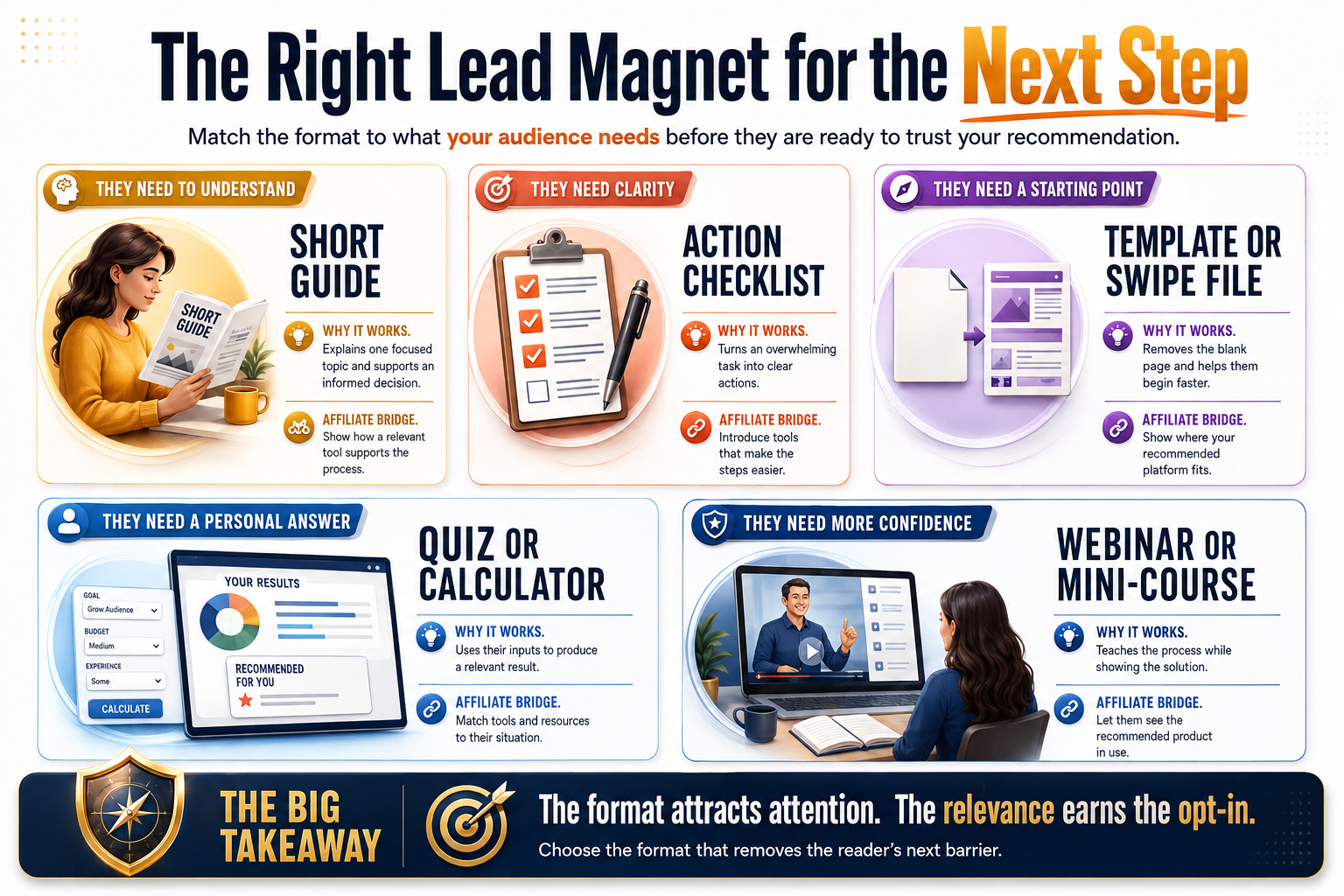
The right format depends on the problem, the audience, and the amount of explanation required.
Checklists
Checklists work well when the reader understands the task but needs help completing it consistently.
Examples include:- Affiliate article publishing checklist
- Website launch checklist
- Product review quality checklist
- Email campaign setup checklist
- Affiliate disclosure checklist
A checklist should help the reader perform the task. It should not become a list of products presented as required purchases.
You can recommend a tool when it clearly simplifies, verifies, or automates one of the steps.
Templates and Worksheets
Templates help readers start faster. Worksheets help them organize information or make a decision.
Useful examples include:- Niche evaluation worksheet
- Affiliate content calendar
- Product comparison template
- Welcome email sequence template
- Campaign tracking sheet
- Product review outline
These formats work particularly well when the affiliate product helps the reader customize, manage, publish, or automate the completed work.
Short Guides
A short guide makes sense when the reader needs context before acting.
Keep the scope narrow.
A useful guide should lead to an informed next step, not merely increase the page count of the download.
Swipe Files
A swipe file provides examples that readers can study and adapt.
Possible formats include:- Affiliate email examples
- Product comparison layouts
- Call-to-action examples
- Review introduction formulas
- Social promotion examples
Explain why each example works. A collection without context may save time, but it does little to improve the reader’s judgment.
Quizzes and Assessments
Quizzes are useful when the correct recommendation depends on the reader’s situation.
Examples include:- Which affiliate niche suits your experience?
- Which email platform fits your business?
- What type of affiliate content should you create first?
- Which website setup matches your needs?
The result logic must remain fair.
Do not direct every participant to the product with the highest commission. Different answers should produce genuinely different recommendations.
Calculators
Calculators help readers estimate a result before making a decision.
Examples include:- Affiliate commission calculator
- Campaign break-even calculator
- Required traffic calculator
- Software cost comparison
- Revenue-per-subscriber calculator
Show the assumptions behind the output. Readers should understand how the result was calculated and which variables may change it.
Mini-Courses and Webinars
These formats suit topics that require several connected lessons or a live demonstration.
A short email course might explain how to choose a niche, plan content, and evaluate products. A webinar might show how a software platform fits into a wider process.
The education should remain useful without a purchase.
The affiliate product should support the lesson rather than become the lesson’s hidden purpose.
How to Create a Lead Magnet People Will Use
A lead magnet cannot create trust if subscribers never finish or apply it.
Solve One Problem
Avoid trying to demonstrate everything you know.
A resource that promises 100 traffic strategies may look valuable, but it also creates a large amount of work for the reader. A focused checklist that helps someone prepare one article for publication may produce a faster and more useful result.
Choose one problem, one promise, and one desired action.
Include the Necessary Context
Concise does not mean incomplete.
A usable resource may need:
- A brief explanation of its purpose
- Clear instructions
- Definitions for unfamiliar terms
- One completed example
- Space to record information
- A suggested next step
Remove material that does not support the outcome. Keep material the reader needs to use the resource correctly.
Make It Easy to Navigate
Design should make the information easier to understand.
Use readable typography, descriptive headings, consistent spacing, and clear labels. Avoid filling every page with decorative elements.
Check the experience on the devices your audience is likely to use. A detailed worksheet may work better as a printable document. A checklist may need a mobile-friendly version.
Test the Resource
Complete the lead magnet yourself before publishing it.
Open every link. Follow each instruction. Enter realistic information into every field.
Then ask someone unfamiliar with the resource to use it without your help.
Their questions will reveal missing instructions, unclear labels, and assumptions you did not notice while creating it.
Keep It Current
Review the resource whenever an important product, process, price, screenshot, or policy changes.
Outdated information can damage credibility even when the rest of the resource remains useful.
Set a regular review schedule for lead magnets connected to software, regulations, or fast-changing industries.
How to Connect a Lead Magnet to an Affiliate Product
A lead magnet should create a natural path to the product rather than force a sale.
Use this progression
Suppose a reader downloads a content planning worksheet.
The worksheet helps organize article ideas. Once the plan is complete, the next challenge may be evaluating demand and competition. A keyword research platform can then become a relevant option.
The recommendation follows the reader’s progress.
Make the Lead Magnet Useful on Its Own
The subscriber should receive the promised result without purchasing the affiliate product.
Do not withhold an essential step and present the product as the only way to finish the resource.
A keyword worksheet should still work manually. A paid platform may make the process faster or provide more data, but it should not be required to understand the worksheet.
Explain the Product’s Role
Avoid vague recommendations.
The second version explains what the product does, when it becomes useful, and why the reader might consider it.
Include Limitations
A balanced recommendation should explain where the product may not fit.
Consider:
- Price
- Learning curve
- Missing features
- Usage limits
- Audience size
- Technical requirements
- Free alternatives
- Manual alternatives
Readers do not need every product immediately. Saying so can strengthen the recommendation for people who genuinely need it.
Place the Recommendation at the Right Point
The product may appear:
- Inside the lead magnet
- On the thank-you page
- In a follow-up email
- In a tutorial
- In a product comparison
- At the end of a mini-course
Choose the point where the reader understands why the product is relevant.
Do not place multiple unrelated affiliate links throughout the resource simply because space is available.

Lead Magnet Ideas for Affiliate Marketers
The following ideas show how the resource can connect to a relevant product category without becoming a sales document.
| Affiliate Niche | Audience Problem | Lead Magnet Idea | Product Connection |
|---|---|---|---|
| SEO | Choosing suitable keywords | Keyword planning worksheet | Keyword research platform |
| Blogging | Planning consistent content | Editorial calendar | SEO or planning software |
| Email marketing | Writing a welcome sequence | Email sequence template | Email marketing platform |
| Website creation | Preparing for launch | Website launch checklist | Hosting or site builder |
| Personal finance | Organizing spending | Monthly budget worksheet | Budgeting software |
| Fitness | Following a consistent routine | Weekly training planner | Fitness program or equipment |
| Creator tools | Managing production tasks | Content workflow template | Project management software |
| Online education | Structuring a course | Course planning worksheet | Course platform |
| Ecommerce | Comparing store requirements | Platform evaluation checklist | Ecommerce software |
| Remote work | Improving a home setup | Workspace planning checklist | Equipment or productivity tools |
These are starting points.
The final idea should reflect the audience you already serve, the content that attracts them, and the products you can recommend responsibly.

How to Promote Your Lead Magnet
A useful lead magnet still needs relevant distribution.
Place It Inside Related Content
Add the offer where it supports the reader’s current task.
A product review outline belongs inside an article about writing affiliate reviews. A niche worksheet belongs inside content about choosing a market.
Use the worksheet to compare your three strongest niche ideas before choosing one to develop.
This is stronger than a generic instruction to download a free resource.
Use Content Upgrades Selectively
A content upgrade is a lead magnet created for a specific article or group of related articles.
It can improve relevance, but you do not need a separate resource for every page.
Create a new lead magnet when the reader’s problem or next step changes significantly. Reuse one strong resource when several articles address the same broader need.
Repurpose the Resource
Use parts of the lead magnet to create:
- Social posts
- Short videos
- Newsletter lessons
- Visual examples
- Guest article sections
- Community answers
Each piece should provide independent value. The lead magnet offers the complete worksheet, process, or template.
Share It With Existing Subscribers
Current subscribers may benefit from a new resource.
If you are comparing possible niches, this worksheet will help you evaluate them using the same criteria.
Avoid promoting the same resource repeatedly without adding a new reason to use it.
Use Relevant Partnerships
Guest content, newsletter collaborations, interviews, and joint workshops can introduce the lead magnet to a related audience.
The resource must fit the collaboration. An unrelated free download will feel promotional even when it is valuable elsewhere.
How to Follow Up With Subscribers
The lead magnet begins the relationship. The follow-up determines whether it continues.
The first email should deliver the resource clearly and promptly. Keep the access link easy to find and explain what the subscriber should do first.
Later emails can:
- Show how to use the resource
- Provide a completed example
- Address a common mistake
- Explain the next problem
- Link to a supporting article
- Introduce a relevant product
- Compare paid and free approaches
Do not turn the delivery email into an aggressive sales message.
Give the subscriber enough time and context to understand the problem before recommending a product. When the recommendation appears, explain why it is relevant and who may not need it.
A short sequence is often enough. The objective is to help the subscriber make progress, not to fill an arbitrary number of emails.
Common Mistakes to Avoid
Lead magnets often underperform because the resource, audience, and affiliate offer are not aligned. The following mistakes can reduce sign-ups, weaken trust, and attract subscribers who are unlikely to engage with your recommendations.
Choosing the Format Before the Problem
Starting with “I should create an ebook” or “I need a quiz” puts the format ahead of the reader.
A lead magnet should begin with a specific problem. Once that problem is clear, choose the simplest format that helps the reader solve it.
A checklist may be enough for a repeatable task. A worksheet may be better for a decision. A short guide may be necessary when the reader needs more context.
Creating a Resource That Is Too Broad
Broad lead magnets often make unclear promises.
A guide called “Everything You Need to Know About Affiliate Marketing” may attract attention, but it does not tell the reader what result to expect. It is also difficult to connect such a broad resource to one relevant affiliate product.
Focus on one audience, one problem, and one outcome.
Attracting the Wrong Subscribers
A popular free resource is not always a useful one.
Giveaways that appeal to a broad audience may increase sign-ups while attracting people with little interest in your niche or affiliate recommendations.
The lead magnet should appeal specifically to readers who need the content, tools, or products you cover.
Adding Too Many Affiliate Links
A lead magnet should not feel like a catalogue of products.
Too many recommendations can distract from the promised result and make the resource appear promotional.
Include an affiliate product only when it supports the reader’s next step. Explain its role clearly and remove links that do not contribute to the outcome.
Promoting Before Delivering Value
Subscribers should not need to work through a sales pitch before receiving the promised resource.
Deliver the lead magnet promptly. Help the reader understand or use it before introducing a product.
The recommendation will feel more relevant when the subscriber understands the problem it solves.
Making the Product Essential to the Resource
A free lead magnet should remain useful without a purchase.
Do not leave out a necessary step and then present the affiliate product as the only way to complete the process.
A paid tool may save time, provide more data, or automate the work. It should improve the process rather than unlock the basic value that was promised.
Ignoring Follow-Up
A download does not create an ongoing relationship by itself.
Without relevant follow-up, subscribers may forget why they joined or never use the resource.
Send the lead magnet clearly, explain how to apply it, address a common problem, and continue the topic before introducing an affiliate recommendation.
Measuring Downloads Instead of Results
A high number of downloads does not prove that the lead magnet is helping the business.
Sign-ups measure initial interest. They do not show whether subscribers used the resource, engaged with later emails, considered the recommended product, or generated affiliate revenue.
Track the wider outcome, including:
- Resource access
- Follow-up engagement
- Affiliate link clicks
- Affiliate conversions
- Revenue per subscriber
- Unsubscribe rate
- Cost per subscriber when using paid traffic
A lead magnet with fewer sign-ups may be more valuable if it attracts readers with stronger intent.
Changing Too Many Variables at Once
Testing several major changes at the same time makes the result difficult to interpret.
If you change the headline, format, placement, and follow-up sequence together, you may improve performance without knowing what caused the improvement.
Test one meaningful variable at a time when possible.
Making Unsupported Product Claims
Avoid promising guaranteed income, higher rankings, faster results, or specific conversion improvements unless reliable evidence supports the claim.
Explain what the product does, how it may help, and which factors remain outside its control.
Precise language is more credible than exaggerated certainty.
Failing to Update the Resource
Lead magnets connected to software, pricing, policies, or fast-changing processes can become outdated quickly.
Old screenshots, broken links, expired offers, and inaccurate product information reduce trust.
Review the resource regularly and update it whenever an important recommendation or process changes.
Affiliate Disclosure and Email Compliance
Transparency begins before a reader downloads your lead magnet. The signup form should explain what they will receive and what type of emails will follow. Someone requesting a checklist or template should not be surprised by unrelated promotional messages.
Affiliate disclosures are required wherever you make a recommendation that could earn you a commission. This may include the article promoting the lead magnet, the resource itself, a product comparison, or a follow-up email.
The disclosure should explain the relationship in direct language and appear close to the affiliate recommendation. Do not rely only on a disclosure in the website footer, terms page, or author biography.
A website disclosure could say:
This article contains affiliate links. If you purchase through one of these links, I may earn a commission at no additional cost to you.
An email disclosure could say:
This email contains affiliate links. I may earn a commission if you purchase through them, at no additional cost to you.
Email compliance extends beyond the affiliate disclosure. Marketing emails should identify the sender accurately, use subject lines that reflect the message, include a valid postal address, and provide a clear way to unsubscribe. The emails should also remain consistent with the expectations established when the reader signed up.
Affiliate programs may impose additional rules on links used in emails, downloadable resources, advertisements, or private communities. Review the current terms of each program before adding its links to a lead magnet or email sequence. Requirements may also differ according to the subscriber’s location.
The Federal Trade Commission’s Endorsement Guides state that financial relationships connected to endorsements should be disclosed clearly and conspicuously. The Federal Trade Commission’s CAN-SPAM Act Compliance Guide for Business states that commercial emails sent in the United States must use accurate sender information, avoid deceptive subject lines, include a valid postal address, provide an opt-out method, and honor opt-out requests within 10 business days.
Conclusion
Lead magnets can strengthen affiliate marketing when they solve a real problem for the right audience.
The resource should help the reader make progress before asking for a purchase. The affiliate product should support the next logical step rather than interrupt the experience.
Start with one focused problem.
Choose a format that fits the task. Create the smallest complete resource that delivers the promised result. Promote it inside relevant content, follow up with useful guidance, and measure what happens beyond the initial download.
The strongest lead magnet is not the one that attracts the most subscribers. It is the one that attracts relevant people, creates a useful result, and gives your recommendation a credible reason to matter.
Frequently Asked Questions
Which Lead Magnets Work Best for Affiliate Marketing?
The best format depends on the reader’s next task. Checklists support repeatable processes, worksheets support decisions, templates reduce setup work, calculators provide estimates, and courses explain multistep topics.
How Do You Connect a Lead Magnet to an Affiliate Product?
Start with a problem the audience already has. Use the lead magnet to help solve part of that problem. Introduce the affiliate product only when it supports the next logical step.
Can You Put Affiliate Links Inside a Lead Magnet?
Some affiliate programs allow it, while others impose restrictions. Review the current program agreement and disclose the affiliate relationship clearly before adding links to a downloadable resource.
How Long Should a Lead Magnet Be?
It should be long enough to deliver the promised result. A checklist may need one page. A technical guide may require more explanation. Length should follow the task.
Should Every Blog Post Have Its Own Lead Magnet?
No. Closely related articles can share one relevant resource. Create a separate lead magnet when the audience problem or desired next step changes substantially.
How Should You Deliver a Lead Magnet?
Send it through an email or automation platform immediately after signup. Make the access link clear and tell the subscriber what to do first.
How Do You Know Whether a Lead Magnet Is Working?
Track opt-ins, resource access, follow-up engagement, affiliate clicks, conversions, revenue per subscriber, and unsubscribes. Downloads alone do not show whether the lead magnet attracts qualified subscribers.
How Often Should You Update a Lead Magnet?
Review it on a regular schedule and whenever an important product, policy, screenshot, process, or link changes. Resources connected to fast-changing software or regulations may require more frequent checks.