Introduction
More traffic is not always the fastest way to grow your email list. A better reason to subscribe often is.
The right lead magnet can turn existing visitors into engaged subscribers by offering something they already want: a faster solution, a clearer answer, a valuable shortcut, or a practical next step.
This guide will cover 13 lead magnet ideas that can help you attract more subscribers, bring in better-fit leads, and create a natural path toward your paid offer.
Key Takeaways
- The strongest lead magnet ideas start with a problem your audience already wants to solve.
- Checklists, templates, quizzes, guides, workbooks, webinars, calculators, and trials work best in different situations.
- A compelling title should make the result clear before someone signs up.
- The right format makes the promised outcome easier to reach instead of adding more work.
- A lead magnet should connect naturally to your paid offer so it attracts people your business can continue helping.
- More pages, features, or complexity do not automatically create more value.
- Placement, delivery, and follow-up all influence how well a lead magnet performs.
- Sign-ups matter, but lead quality, engagement, and customer fit matter more.
Affiliate Disclosure: Some of the links on this site are affiliate links. That means if you click and make a purchase, I may earn a small commission at no extra cost to you.
What Makes a Lead Magnet Worth Downloading
A lead magnet does not earn attention because it is a checklist, quiz, template, or guide. It earns attention because the promise feels relevant and the result feels worth the email address.
The strongest offers solve a clear problem, deliver a specific outcome, and make the next step easier. They also connect naturally to what your business sells, so the people who subscribe are more likely to care about your future emails and offers.
That is the standard behind the ideas below. Each format can work well when the topic, audience, and promise fit together and each can underperform when they do not.
13 Lead Magnet Ideas That Can Grow Your Email List
Checklists
A strong checklist gives people something they can use immediately.
It works best when your audience already knows the goal but needs help remembering the steps, avoiding mistakes, or completing the process in the right order. That makes checklists a natural fit for launches, audits, onboarding, planning, and repeatable tasks.
The Blog Post Launch Checklist: 18 Steps to Complete Before You Publish
The title works because it names the task, sets a clear scope, and promises to help the reader avoid missing something important.
To make a checklist more compelling, focus on one specific moment instead of an entire subject. “The Complete Marketing Checklist” feels broad and exhausting. “The 12-Point Landing Page Review Checklist” feels faster, clearer, and easier to use.
A checklist can also lead naturally to a related service, course, or tool. Someone reviewing a landing page, for example, may be ready for a copy audit or conversion-focused template next.
Templates
Templates attract subscribers because they remove the hardest part of many tasks: starting from a blank page.
They work especially well when the reader understands what needs to be created but wants a faster structure, stronger starting point, or more professional result. Email scripts, content calendars, proposals, budgets, and planning documents can all become effective template-based lead magnets.
15 Follow-Up Email Templates for Leads Who Have Gone Quiet
That promise is more persuasive than “Free Email Templates” because it targets a recognizable problem and a specific situation.
The best templates are not finished work disguised as shortcuts. They give the user enough structure to move faster while leaving room to adapt the language, details, and decisions to their own needs.
Add brief instructions, examples, or notes showing how to customize the template. That extra guidance can turn a basic download into a resource people actually use and remember who gave it to them.
Quizzes and Assessments
Quizzes can turn a passive visitor into an active participant.
They are most effective when the answers lead to a meaningful result, recommendation, score, or next step. A good quiz should help the user understand something about their situation, not simply assign them a flattering label.
What Is Slowing Down Your Email List Growth? Take the 3-Minute Assessment
The result could identify issues such as weak offers, poor visibility, unclear positioning, or inconsistent follow-up. Each outcome could then recommend a relevant guide, checklist, or service.
Quizzes can also help you segment new subscribers based on their goals, challenges, or level of experience. That information can make future emails more relevant, provided you explain what you collect and use the data responsibly.
Avoid making the experience longer than the insight justifies. If the quiz asks 20 questions and delivers a vague result, it will feel like work. Keep the path focused and make the result specific enough to reward the effort.
Mini-Courses
Mini-courses work well when the audience needs more than a quick download but is not ready for a full program.
They are especially effective for topics that require a sequence: learning a skill, changing a habit, completing a setup, or making progress over several days. Each lesson should move the subscriber closer to one clear outcome.
5 Days to a Stronger LinkedIn Profile
The promise is focused, the time commitment is clear, and each lesson can cover one practical improvement such as the headline, About section, featured content, or call to action.
A strong mini-course does not try to teach everything. It creates a few meaningful wins that show the value of your approach and give subscribers a reason to keep opening your emails.
Keep each lesson short enough to complete without disrupting the reader’s day. Then end the course with a relevant next step, such as a deeper training, consultation, template, or paid program.
Guides and eBooks
Guides and eBooks are still powerful when the topic genuinely requires depth.
They are a good fit when your audience needs context, examples, comparisons, or a clear framework before taking action. A detailed guide can help readers understand a complicated subject without having to piece together information from several sources.
The Small Business Guide to Choosing an Email Marketing Platform
This title works because it names the audience, the decision, and the purpose. The guide could compare key features, pricing considerations, ease of use, and the questions a business owner should ask before choosing.
The strongest guides are easy to scan. Use clear headings, short sections, examples, visuals, and summaries so readers can find what matters without reading every word in order.
Do not add pages simply to make the resource look more valuable. Depth earns attention when it helps the reader make a better decision or understand a difficult topic, not when it repeats the same point in five different ways.
Worksheets and Workbooks
Worksheets and workbooks help readers move from understanding an idea to applying it.
They are useful when the outcome requires planning, reflection, calculation, prioritization, or written decisions. Instead of only telling someone what to do, the resource gives them a place to do part of the work.
The 30-Minute Offer Clarity Workbook
The workbook could guide the reader through defining the audience, identifying the main problem, shaping the promise, and choosing the next step. By the end, they would have something tangible to use, not just more information.
A good workbook should feel focused and easy to complete. Avoid filling it with broad questions that require long, uncertain answers. Clear prompts produce better momentum.
Include short examples where helpful, and explain what the reader should have completed by the end. That makes the resource feel purposeful and can create a natural bridge to coaching, consulting, or a more advanced program.
Toolkits and Resource Lists
Toolkits are attractive because they save people from doing hours of research on their own.
They work best when your audience needs several trusted resources to complete a task, compare options, or build a system. A strong toolkit does more than list links. It explains what each resource is for, when to use it, and why it earned a place.
The Essential Content Creator Toolkit: 12 Tools for Planning, Writing, and Publishing
The resource could group tools by purpose and include a short explanation, pricing note, and recommended use case for each one.
Curation is where the value lives. A list of 50 random tools creates more work. A focused collection of 10 carefully selected resources can help readers make decisions faster and avoid options that do not fit their needs.
If the toolkit includes affiliate links, disclose that clearly. Trust grows when readers understand how recommendations were chosen and whether you may earn a commission.
Webinars and Live Trainings
Webinars give people the chance to learn from you in real time.
They are a strong choice when the topic benefits from demonstration, explanation, examples, or live questions. They can also help potential customers experience your teaching style before deciding whether to buy.
How to Create a Lead Magnet People Want to Download
A focused session like this could explain how to choose the topic, shape the promise, select the format, and connect the resource to a relevant offer.
The strongest webinars revolve around one clear result. Avoid trying to cover an entire subject in a single session. A narrower promise usually makes the training easier to understand, promote, and deliver well.
Give attendees real value before introducing a paid offer. The transition should feel like a logical next step for people who want more help, not a sudden sales pitch after an hour of withheld information.
You can also offer the replay as an evergreen lead magnet, provided the content remains accurate and the registration experience is clear.
Swipe Files
Swipe files give readers strong examples they can study, adapt, and learn from.
They work especially well in copywriting, design, content marketing, email marketing, and sales areas where seeing effective patterns can make the principles easier to understand.
25 Welcome Email Examples With Notes on Why They Work
The commentary is what turns a collection into a valuable lead magnet. Explain the opening, structure, tone, call to action, and strategic choices behind each example.
A swipe file should inspire original work, not encourage careless copying. Identify the source when appropriate, link to public examples, respect copyright, and avoid sharing private or proprietary material without permission.
You can make the resource even more useful by adding prompts such as:
- What makes the opening effective?
- How is the offer introduced?
- What could be adapted for a different audience?
- Which parts should not be copied directly?
That approach helps readers understand the thinking behind the examples instead of treating them as shortcuts to duplicate.
Email Challenges
Email challenges turn one large goal into a short series of manageable actions.
They work best when progress depends on consistency rather than a single download. Each email should give the subscriber one clear task, help them complete it, and prepare them for the next step.
The 5-Day Welcome Email Challenge
Over five days, subscribers could define the purpose of their sequence, write the opening email, introduce their offer, strengthen the call to action, and review the complete flow.
The strongest challenges create visible progress without overwhelming the participant. Keep the daily task focused enough to complete in a reasonable amount of time, and explain what the reader will have by the end.
A challenge can also build a natural connection to a paid offer. Someone who completes a short copywriting challenge may be ready for a template pack, course, audit, or done-for-you service that helps them improve the finished result.
Avoid stretching a simple lesson across several days just to increase email volume. Every message should earn its place.
Calculators and Generators
Calculators and generators are compelling because they turn general information into a personalized result.
They work especially well when your audience needs help estimating a cost, comparing options, creating a starting point, or making a decision based on their own information.
Email List Growth Calculator: Estimate How Many Subscribers You Could Add Each Month
The calculator might use website traffic, opt-in rate, and campaign frequency to produce a simple estimate. The result could then suggest which area offers the clearest opportunity for improvement.
Generators can create similar value by producing subject-line ideas, content prompts, names, outlines, or recommendations based on a few inputs.
The output must be meaningful enough to justify the information requested. Keep the form focused, explain how the result is calculated, and avoid presenting an estimate as a guarantee.
When the tool collects personal or business information, tell users what will be stored, how it will be used, and whether the results are delivered by email.
Case Studies
Case studies show what your process looks like when applied to a real problem.
They are especially persuasive when potential customers want evidence before trusting a service, strategy, or higher-priced offer. A strong case study does more than announce an impressive result. It explains the starting point, decisions, work completed, challenges, and outcome.
How We Turned One Blog Post Into a Lead Magnet That Generated 327 Subscribers
That title can be powerful when the number is accurate, the result can be documented, and the article explains the context behind it.
A useful case study usually follows a clear structure:
- The original problem or goal
- The approach that was chosen
- The work completed
- The measurable outcome
- What influenced the result
- Lessons the reader can apply
Specific numbers make a case study stronger, but only when they are honest and properly framed. Include the time period, traffic source, audience, and other factors needed to understand what the result actually means.
When a client or customer is involved, get permission before sharing identifying details, private information, screenshots, or performance data. If the example is anonymized, say so clearly.
A well-written case study can attract highly relevant leads because it helps readers recognize their own problem and see how your expertise could help solve it.
Free Trials and Exclusive Offers
Sometimes the strongest lead magnet is not a guide or template. It is the chance to experience the product itself.
Free trials, samples, credits, and exclusive introductory offers work best when the value becomes clear through use. They are especially effective for software, memberships, subscriptions, and products people may hesitate to buy without trying first.
Try the Complete Email Planning Tool Free for 14 Days
The promise is direct: the subscriber gets access, uses the product, and decides whether it fits their needs.
A strong trial should help people reach a meaningful result before access ends. If the setup takes ten days and the trial lasts fourteen, users may never experience the benefit that could persuade them to continue.
Make the terms easy to understand. Explain:
- What is included
- How long access lasts
- Whether payment details are required
- What happens when the trial ends
- Whether the subscription renews automatically
- How users can cancel
Exclusive discounts can also attract leads when the offer is real and relevant. A first-order discount, event-only price, or early-access rate can give interested buyers a clear reason to act.
Avoid manufactured scarcity or pretending an offer is exclusive when it is permanently available to everyone. Strong copy can create urgency without hiding conditions or inventing pressure.
Trials and discounts may generate sign-ups quickly, but the number of leads is only part of the result. Pay attention to activation, purchases, renewals, refunds, and long-term fit. A smaller group of people who genuinely want the product is more valuable than a large list attracted only by a discount.
The best version of this lead magnet lowers the risk of taking the next step while allowing the product to prove its value.
How to Choose the Right Lead Magnet Idea
The best lead magnet is not always the most creative one. It is the one that gives the right audience a compelling reason to subscribe.
Start With the Problem
Before choosing a format, identify the problem your audience already wants to solve.
- A checklist works when people need steps.
- A template works when they need a starting point.
- A quiz works when the value depends on a personalized answer.
Start with the outcome, then choose the format that makes that outcome easiest to deliver.
Match the Idea to the Buying Journey
Different lead magnets attract people at different stages.
The closer the lead magnet is to your paid offer, the easier it becomes to attract subscribers who are likely to care about what comes next.
Choose a Format Your Audience Will Actually Use
A sophisticated lead magnet is not automatically a better one.
Think about how much time, effort, and attention the reader is willing to give. The format should make the result easier to reach, not create another obstacle.
Make the Connection to Your Offer Clear
A lead magnet should solve a problem related to what your business helps people do.
- A copywriter might offer a welcome email checklist.
- A fitness coach might create a meal-planning workbook.
- A software company might provide a calculator or free trial.
The connection does not need to feel like a sales pitch. It simply needs to make sense.
When the free resource and paid offer solve related problems, the subscribers you attract are more likely to be a strong fit.
Choose the Smallest Complete Version
Do not make the lead magnet bigger than the promise requires.
A focused five-page workbook can be more valuable than a 50-page guide filled with repetition.
A short quiz can outperform a long assessment when the result is clear and relevant.
Create the smallest version that fully delivers the promised outcome. You can always expand it after seeing how people respond.
The goal is not to impress people with the size of the resource. It is to make them glad they signed up.
How to Turn a Good Idea Into a Lead Magnet People Want
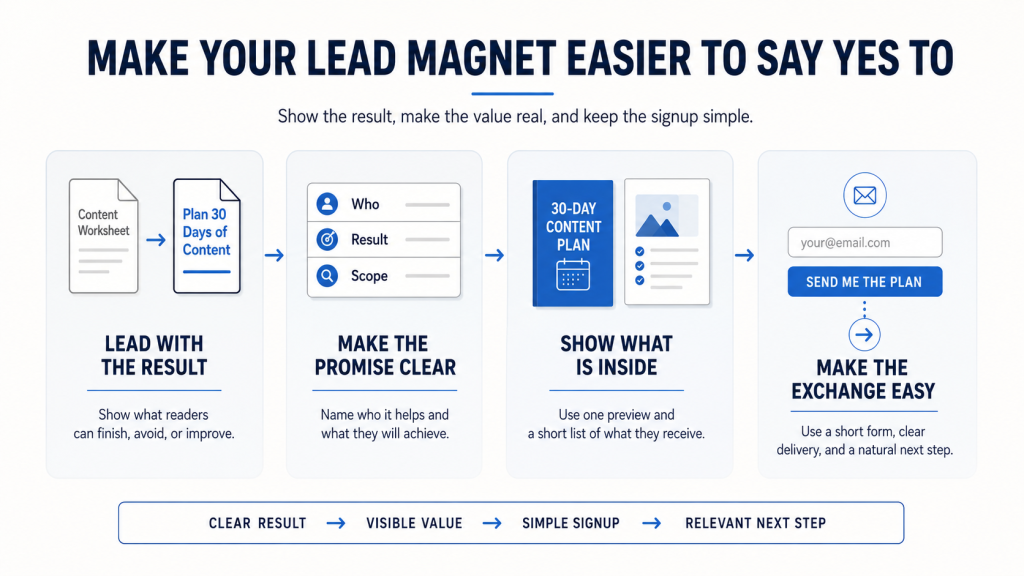
A strong format helps, but the way you position the offer determines whether people stop, care, and subscribe.
Lead With the Result
People do not download a checklist because they love checklists. They download it because they want to avoid mistakes, save time, or finish something with more confidence.
Focus the title on the result, not the file type.
The second version gives the reader a clearer reason to care.
Make the Promise Specific
Broad promises are easy to ignore.
“Grow Your Business” could mean almost anything. “Find Three Places Your Website Is Losing Leads” creates a more concrete expectation.
A strong promise usually answers at least two of these questions:
- Who is it for?
- What will it help them do?
- How quickly can they use it?
- What mistake or frustration will it help them avoid?
- What will they have when they finish?
Specificity makes the value easier to picture.
Show What They Are Getting
Do not make visitors guess what is behind the form.
Show a sample page, quiz result, lesson title, calculator preview, or screenshot of the template. A clear preview makes the offer feel more real and reduces uncertainty.
You can also name what is included:
- 12-point checklist
- Five editable templates
- Three short lessons
- Personalized score and recommendations
- Step-by-step workbook
The goal is not to explain every detail. It is to make the value tangible before the signup.
Remove Unnecessary Friction
Every extra step gives someone another reason to leave.
Ask only for the information you genuinely need. Make the form easy to complete, keep the button text clear, and deliver the resource immediately.
The signup experience should answer three questions without confusion:
- What will I receive?
- Where will it be sent?
- What happens after I subscribe?
Clear expectations build confidence and make the exchange feel straightforward.
Connect the Lead Magnet to the Next Step
A good lead magnet should deliver the promised value on its own. It should also make the next step feel natural.
- A checklist can lead to an audit.
- A workbook can lead to coaching.
- A case study can lead to a consultation.
- A free trial can lead to a paid subscription.
The connection works best when the next offer helps the subscriber go further, move faster, or get support applying what they just learned.
Do not force the transition. Earn it by making the lead magnet genuinely valuable first.
Conclusion
The best lead magnet is not the one with the most pages, the most elaborate design, or the trendiest format.
It is the one that gives the right person a compelling reason to subscribe.
A strong lead magnet solves a problem your audience already cares about, makes the value clear before the signup, and delivers enough substance to build trust after it. When the topic also connects naturally to what your business offers, the list you grow becomes more than a collection of email addresses. It becomes an audience with a real reason to keep listening.
Choose one problem. Match it with the right format. Make the promise specific. Then create the smallest complete resource that delivers the result well.
You do not need all 13 ideas. You need the one your audience is most likely to want and your business is best prepared to deliver.
Frequently Asked Questions
Which lead magnet idea should I start with?
Start with the problem your audience most wants to solve. Then choose the format that makes the solution easiest to understand or use. A checklist may fit a repeatable task, while a template, guide, quiz, or calculator may be better for a different type of result.
Which type of lead magnet converts best?
There is no single format that converts best for every business. Performance depends on the audience, topic, promise, placement, and quality of the offer. A simple checklist can outperform a detailed guide when it matches the reader’s immediate need more closely.
How long should a lead magnet be?
It should be long enough to deliver the promised result and no longer. Some problems can be solved with a one-page checklist, while others require a workbook, guide, training, or course. Depth is valuable when the topic needs it.
Can a free trial or discount be a lead magnet?
Yes. Trials, samples, credits, and exclusive offers can work as lead magnets when they give people a meaningful way to experience the product or reduce the risk of trying it. The terms should always be clear.
How many lead magnets should a business create?
One focused lead magnet is enough to begin. Test how well it attracts the right subscribers before creating more. Additional lead magnets can later target different audience problems, services, or stages of the buying journey.
How do I know whether my lead magnet is attracting quality leads?
Look beyond the number of sign-ups. Track email engagement, replies, clicks, consultations, trials, purchases, and long-term customer fit. A smaller list of relevant subscribers can be more valuable than a larger list of people who only wanted the free resource.
Pingback: Lead Magnet Examples That Actually Convert - Lead Magnets Creator
Pingback: AI Lead Magnets: How AI Tools Create High-Converting Lead Magnets in Minutes - Lead Magnets Creator