A lead magnet can look polished, promise a quick win, and still give people no real reason to sign up.
The format is rarely the whole story. What makes the offer appealing is how well the topic, promise, audience, and delivery fit together. A simple checklist may feel more valuable than a detailed guide when it helps someone solve the right problem at the right moment.
In this article, we will examine five real lead magnet examples, break down what makes each one worth studying, and show you how to adapt the strategy behind them without copying the asset itself.
Key Takeaways
- A lead magnet becomes worth signing up for when it solves a specific problem, promises a desirable result, and delivers exactly what the offer describes.
- The format is only effective when it matches what the audience needs, whether that is clarity, structure, personalization, evidence, or guided progress.
- Other businesses’ lead magnets are most valuable as sources of strategic insight, not assets to copy.
- Adapt the principle behind an example to your own audience, expertise, and offer so the final resource feels relevant and original.
- Avoid choosing a format because it looks impressive, making a promise the resource cannot fulfill, or attracting subscribers who have little reason to value what your business offers next.
- Sign-ups show initial interest, but engagement and movement toward a relevant next step provide a clearer picture of whether the lead magnet is doing its job.
Affiliate Disclosure: Some of the links on this site are affiliate links. That means if you click and make a purchase, I may earn a small commission at no extra cost to you.
What Makes a Lead Magnet Worth Signing Up For
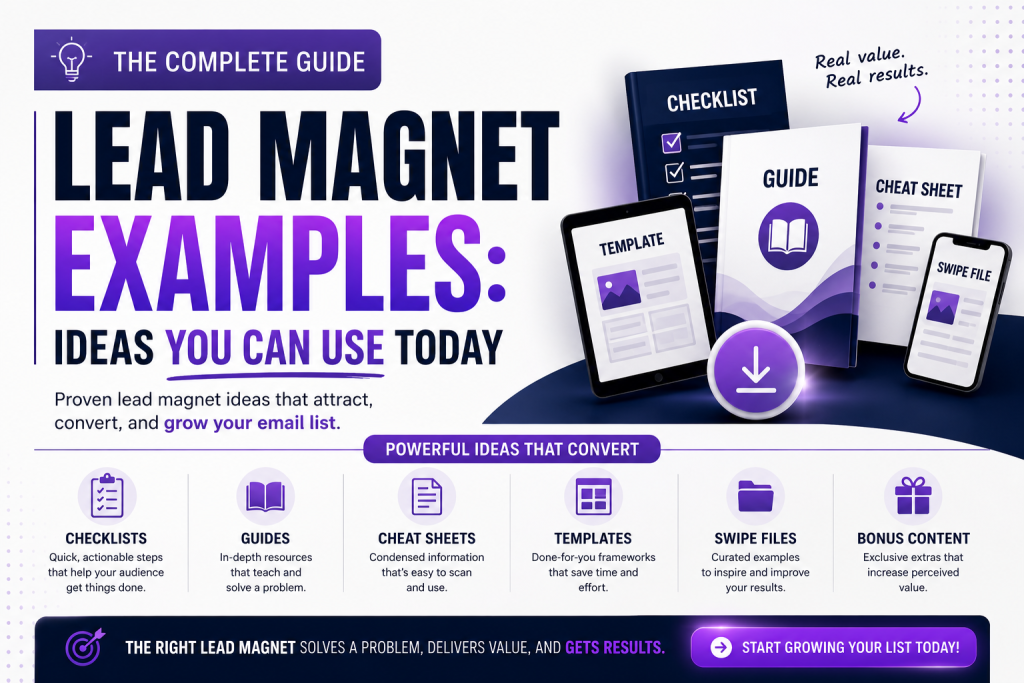
People do not sign up because a resource is called a checklist, guide, quiz, or toolkit. They sign up because the offer feels relevant enough to interrupt what they are doing.
The strongest lead magnets make the exchange feel simple: the reader gives an email address and receives something that helps them solve a problem, make a decision, or move forward with greater confidence.
The Problem Feels Specific and Relevant
A broad topic may attract casual interest, but a specific problem gives people a reason to act.
Compare these two ideas:
The first could cover almost anything. The second speaks to a clear audience, task, and situation.
Specificity helps the reader recognize that the resource was made for someone like them. It also gives the creator a clearer boundary for what to include.
The Promise Is Easy to Picture
A strong promise helps readers understand what they will gain before they sign up.
That outcome might be:
- A finished first draft
- A clearer decision
- A personalized recommendation
- A faster way to complete a task
- A better understanding of a problem
- A collection of examples they can study
The promise does not need to sound dramatic. It needs to feel meaningful.
“Plan your week in 15 minutes” creates a clearer picture than “Become more productive.” Likewise, “Compare five pricing models for your consulting offer” is easier to evaluate than “Grow your business with confidence.”
Readers are more likely to value an offer when they can imagine using the result.
The Format Fits the Result
The format should make the promised outcome easier to achieve.
A checklist works well when the reader needs to review a process or avoid missing a step. A template can reduce the effort required to begin. A quiz may help someone evaluate their situation, while a detailed guide may suit a problem that needs context and explanation.
No format is automatically more persuasive than another.
A short resource can feel incomplete when the problem requires depth. A long report can feel exhausting when the reader only needs a quick answer.
Choose the format based on what the reader needs to do—not what happens to be popular.
The Resource Feels Worth the Exchange
An email address may seem like a small request, but subscribers know it can lead to future messages, promotions, and follow-up.
The resource should therefore feel more valuable than information they could find in a few seconds through a basic search.
That value might come from:
- Original analysis
- First-hand experience
- A thoughtful shortcut
- Carefully organized information
- A practical tool
- Personalized feedback
- Examples gathered in one place
- A process that reduces confusion
The lead magnet does not always need to be fast, short, or simple. A buyer researching an expensive service may gladly spend time with a detailed comparison guide. Someone facing an immediate task may prefer a one-page checklist.
What matters is whether the depth matches the decision or problem.
Delivery Matches the Expectation
A compelling landing page can earn the signup, but the resource still has to fulfill the promise.
If the offer promises a template, subscribers should receive something they can actually use, not a promotional PDF that merely explains why templates matter.
When a guide promises specific examples, the examples should be substantial enough to study. If a quiz offers personalized recommendations, the results should feel meaningfully connected to the answers.
Small details also shape the experience:
- The file opens without difficulty.
- The design supports readability.
- Instructions are clear.
- Links work.
- The promised content is easy to find.
- Delivery happens when expected.
A lead magnet should not feel smaller once the reader opens it.
The Topic Connects to the Business
The best lead magnets do more than attract attention. They introduce the kind of problem the business is qualified to help solve.
A website copywriter might offer a homepage checklist. A financial consultant could provide a cash-flow planning worksheet. A fitness coach may create a short mobility assessment.
The connection should make sense without forcing a sales pitch into the resource.
When the lead magnet and paid offer solve completely unrelated problems, the business may gain subscribers who have little reason to stay engaged. A focused topic helps attract people who are more likely to value the follow-up.
A lead magnet becomes worth signing up for when the reader can quickly understand three things: this is for me, this can help me, and the result is worth the exchange.
5 Real Lead Magnet Examples Worth Studying
A strong example does not hand you a formula to copy. It gives you a clearer view of how another business connects an audience problem, an appealing promise, and a relevant offer.
The following lead magnets use different formats, but each one gives the reader a specific reason to engage.
HubSpot’s AEO Grader : Turn Curiosity Into a Personalized Result
HubSpot’s AEO Grader helps businesses examine how their brands appear in AI-generated answers. Instead of offering a general guide to answer engine optimization, the tool gives users a result based on their own brand.
That personal element strengthens the offer. A visitor is not simply learning about a growing marketing topic, they are finding out how it may affect their business.
The grader also fits naturally with HubSpot’s broader answer engine optimization tools. The free experience introduces the problem, gives the user an initial view of their situation, and creates a reason to explore more advanced monitoring.
An assessment becomes more appealing when the result feels personal and leads to a decision the user already needs to make. The questions and recommendations should also connect directly to the expertise or service your business provides.
Hootsuite’s Competitive Analysis Template : Make a Complicated Task Easier to Start
Hootsuite offers a customizable spreadsheet for analyzing competitors’ social media performance, content, and strategy.
Competitive research can feel important but vague. Many marketers know they should do it without knowing what information to collect or how to organize it.
The template reduces that starting barrier by providing a ready-made structure. It also aligns closely with Hootsuite’s role as a social media management and competitive analysis platform.
A template can be desirable even when the information behind it is not new. The value may come from helping readers organize their thinking, begin faster, and avoid building a process from an empty page.
Copyhackers’ 10x Emails Lesson : Let Prospects Experience the Teaching
Copyhackers offers a free sample lesson from its 10x Emails course. The lesson includes email-writing instruction, templates, and strategies drawn from the larger paid program.
This approach does more than describe the course. It gives prospective students a chance to experience the teaching style and decide whether the material fits the way they want to learn.
The free lesson also stays close to the paid offer. Someone who wants help writing emails is introduced to a course that addresses the same challenge in greater depth.
A lead magnet can serve as a meaningful sample of a paid experience. The free material should stand on its own while giving readers an honest view of the depth, style, and support available next.
Unbounce’s Conversion Benchmark Report : Offer Information Readers Cannot Easily Gather Alone
Unbounce’s Conversion Benchmark Report provides landing-page performance data across industries. The report is based on 57 million conversions, 464 million visits, and more than 41,000 landing pages collected during the report’s stated research period.
This makes the resource different from a general guide. Most individual marketers do not have access to enough data to create meaningful industry benchmarks on their own.
The topic also connects directly to Unbounce’s platform. Readers interested in landing-page performance are likely to care about building, testing, and improving landing pages.
Original data can make a compelling lead magnet when it answers a question your audience cannot resolve through a quick search. Explain the methodology clearly so readers can understand what the findings represent—and what they do not prove.
Semrush’s Content Marketing Starter Kit : Combine Resources Around One Clear Goal
Semrush’s Content Marketing Starter Kit includes a workbook and templates for buyer personas, brand stories, tone of voice, competitive analysis, content funnels, planning, and calendars.
That may sound like a broad collection, but the resources support one larger task: building a foundation for a content marketing plan.
The kit appeals to readers who need more than one worksheet but are not ready to design an entire planning system themselves. It also introduces several areas where Semrush’s research and marketing tools may become relevant.
A toolkit does not need to solve only one small task. It can support a larger outcome when every included resource has a clear role. Avoid adding bonuses that inflate the number of assets without helping the reader complete the main job.
These examples are not valuable because they use five supposedly superior formats. They are valuable because the format, promise, audience problem, and business expertise fit together.
HubSpot personalizes the result. Hootsuite reduces the effort required to begin. Copyhackers offers a genuine preview. Unbounce provides difficult-to-access data. Semrush organizes several tools around one larger goal.
Those are the principles worth adapting.
How to Adapt These Examples to Your Business
The goal is not to recreate HubSpot’s assessment, Hootsuite’s template, or Semrush’s toolkit with different branding.
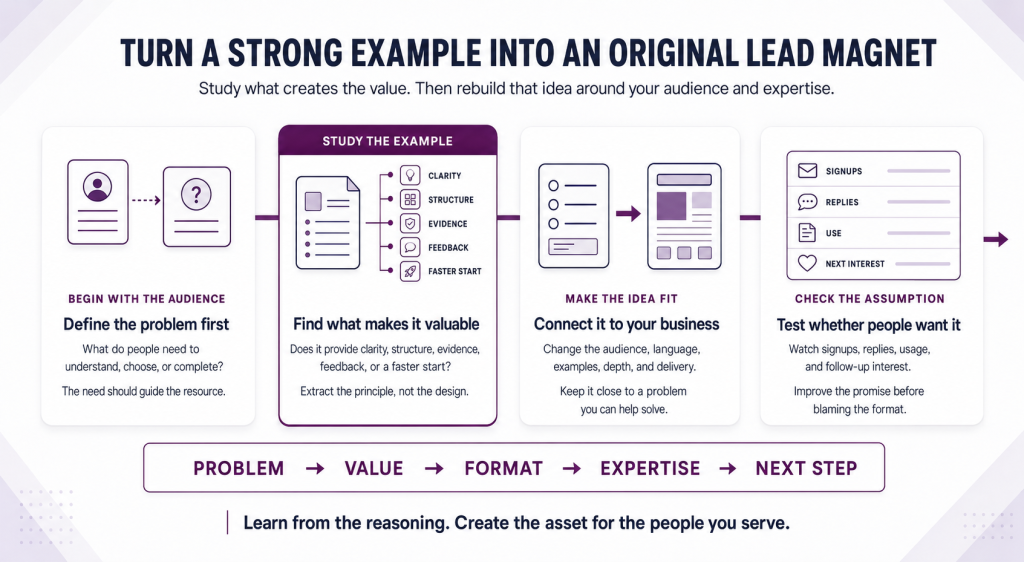
The better approach is to identify what makes each offer valuable, then rebuild that principle around your own audience, expertise, and offer.
Start With the Problem, Not the Format
The problem should guide the format.
A checklist may suit a process readers need to review. A template can help them begin a difficult task. An assessment may work when they need a personalized result, while a detailed report may be appropriate when the decision requires deeper information.
Choosing the format first can lead to an attractive resource that solves the wrong problem.
Identify What Creates the Value
Look past the surface of each example.
The value is not simply that HubSpot created a grader or that Hootsuite offered a spreadsheet. Each resource reduces a different kind of friction:
- HubSpot provides a personalized result.
- Hootsuite makes a complex task easier to begin.
- Copyhackers lets prospects experience the teaching.
- Unbounce provides data readers cannot easily collect themselves.
- Semrush organizes several resources around one larger goal.
Ask what your audience finds difficult.
Do they need clarity, structure, examples, evidence, feedback, or a faster starting point? Your answer will reveal what the lead magnet should actually provide.
Match the Idea to Your Expertise
A lead magnet should introduce people to a problem your business is equipped to help solve.
A website designer might create a homepage planning worksheet. A business coach could offer a decision-making assessment. An accountant may provide a cash-flow preparation checklist.
The connection does not need to feel like a disguised sales pitch. It should simply make sense.
Someone who benefits from the free resource should also have a reasonable reason to value your paid product or service.
When the topic attracts attention but has little connection to the business, the subscriber may enjoy the resource and still have no interest in what comes next.
Rebuild the Concept for Your Audience
Once you identify the principle, adapt it to the people you serve.
That may involve changing:
- The problem addressed
- The language used
- The level of detail
- The examples included
- The format
- The delivery method
- The next step
Suppose you like Hootsuite’s competitive analysis template. A direct copy would recreate its categories, wording, and structure.
A thoughtful adaptation would ask what your audience needs to compare.
A freelance designer might create a client website review sheet. A career coach could develop a job-offer comparison worksheet. A consultant may offer a vendor evaluation template.
The underlying value remains the same: helping someone organize a complicated decision. The asset itself becomes original and relevant.
Test the Assumptions Behind the Idea
A promising concept is still an assumption until your audience responds to it.
Test whether people understand:
- Who the resource is for
- What problem it addresses
- What they will receive
- Why the outcome matters
- How much effort it requires
You can learn from signup rates, replies, follow-up clicks, usage patterns, and conversations with subscribers.
Low interest does not always mean the format is wrong. The topic may be too broad, the promise may be unclear, or the landing page may not show enough value.
Avoid assuming that an idea will work simply because a larger company uses something similar.
A practical way to shape the offer is:
Begin with the audience’s problem. Decide what kind of value would help. Choose a format that delivers it well. Connect the resource to your expertise, then guide the subscriber toward a relevant next step.
That process helps you learn from strong examples without turning someone else’s asset into your own.
What to Avoid When Using Other’s Lead Magnets as Inspiration
Examples can make the planning process easier, but they can also create false confidence.
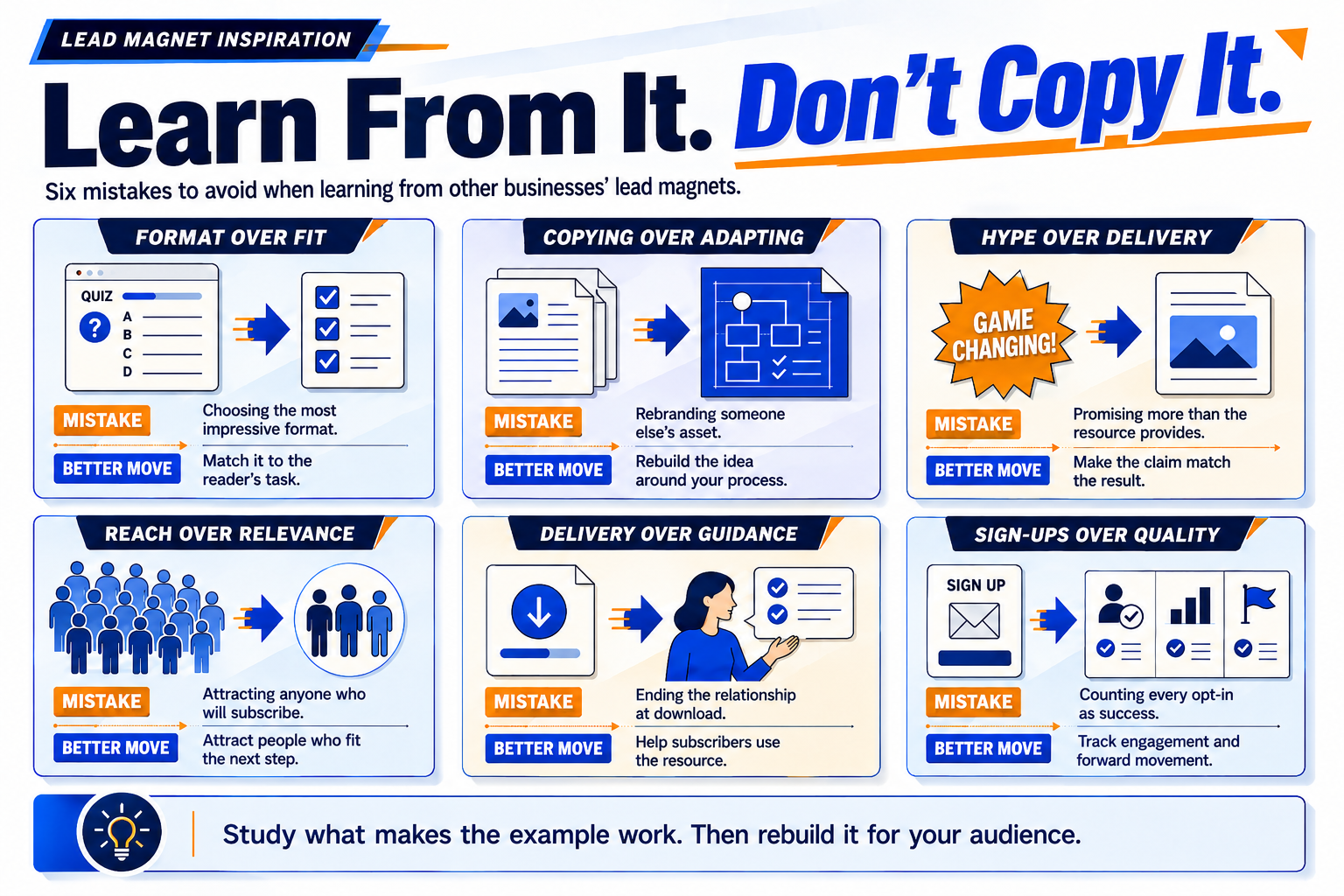
A format that looks impressive in another business may fail when the audience, promise, or offer is different. The goal is to study the reasoning behind the example, not assume the visible asset is the reason it works.
Copying the Format Without Checking the Fit
Seeing a polished quiz or toolkit can make the format feel like the obvious choice.
That is where many lead magnets go off course.
A quiz may suit an audience that wants a personalized recommendation, but it may feel unnecessary when the reader only needs a short checklist. A detailed guide can be valuable for a complex decision and excessive for a simple task.
Before choosing the format, ask:
- What does the reader need to accomplish?
- How much explanation does the problem require?
- Would personalization improve the result?
- How much time is the reader likely to invest?
- Can the format deliver the promise clearly?
The strongest format is not the most impressive one. It is the one that makes the result easier to achieve.
Recreating the Asset Too Closely
There is a difference between adapting an idea and reproducing someone else’s work.
Changing the colors and logo does not make a copied asset original. The title, wording, organization, examples, design, and distinctive features may still be too similar.
Instead, identify the broader principle.
A competitive analysis template may inspire you to create a structured comparison tool. That does not mean you need to copy the same categories, instructions, or layout.
Build the resource around your audience’s decisions, your process, and your expertise.
Making a Bigger Promise Than the Resource Delivers
A strong promise creates desire. An inflated promise creates disappointment.
The problem is not using confident or appealing language. The problem begins when the title suggests a result the resource cannot reasonably provide.
For example:
The second title may sound less dramatic, but it tells the reader what the resource actually does.
Before publishing, compare the landing-page promise with the final asset. Ask whether the subscriber can reasonably expect to receive the stated result from the resource alone.
A lead magnet should feel at least as valuable after the download as it did before the signup.
Choosing a Topic That Attracts the Wrong Audience
A broad topic can generate attention while doing little for the business behind it.
Imagine a web designer offering a general productivity planner. The resource may attract plenty of people, but many of them may have no interest in website strategy or design services.
A more relevant lead magnet might help business owners prepare content for a website project or evaluate whether their homepage communicates the right message.
The topic does not need to describe the paid service directly. It should address a problem that naturally connects to the work you do.
More subscribers are not always better when the resource attracts people who are unlikely to value the next step.
Treating the Download as the Finish Line
Delivering the file completes the promise, but it should not end the relationship.
A short follow-up can help subscribers use the resource, understand the next step, and see how the topic connects to your broader expertise.
That follow-up might:
- Explain how to begin
- Highlight one section people often overlook
- Share an example of the resource in use
- Answer a common question
- Introduce a related article, product, or service
The transition should feel helpful rather than forced.
Someone who downloads a homepage checklist may reasonably appreciate guidance on reviewing their results. They may be less interested in an unrelated promotion sent immediately afterward.
Measuring Success Only by Sign-Ups
A high opt-in rate can look encouraging, but it does not tell the full story.
A lead magnet may attract many subscribers who never open the resource, engage with the follow-up, or show interest in the related offer.
Look beyond the initial signup.
Depending on the business, useful signals may include:
- Email engagement
- Replies
- Clicks to related resources
- Resource usage
- Consultation requests
- Product interest
- Subscriber retention
- Customer conversion
These signals should be interpreted carefully. A later purchase may be influenced by several messages, experiences, and interactions, not the lead magnet alone.
The purpose of measurement is not to prove that one asset caused every result. It is to understand whether the lead magnet is attracting the right people and helping them move forward.
Strong examples can shorten the learning curve, but they cannot replace judgment. Study what makes the offer appealing, then rebuild the idea around your own audience, promise, and business.
Conclusion
Strong lead magnet examples can save you from starting with a blank page, but their real value is not in the format alone.
What matters is the thinking behind the asset: the problem it addresses, the promise it makes, the value it delivers, and the way it connects to the business behind it.
Use other businesses’ lead magnets as evidence of what is possible, not as blueprints to reproduce. Study what makes the offer appealing, then rebuild that principle around your own audience, expertise, and next step.
Choose one example from this article and ask:
- What problem does it solve?
- Why does the format fit?
- What makes the offer desirable?
- How could I apply that idea in an original way?
The best lead magnet is not the one that looks most impressive. It is the one that makes sense for your audience, your expertise, and the problem you are ready to help solve.

Frequently Asked Questions
Which type of lead magnet should I create?
Choose the format that best fits the problem your audience wants to solve. A checklist, quiz, template, guide, or toolkit can all work when the format supports the promised result.
Can I use another company’s lead magnet idea?
You can learn from the underlying concept, but rebuild the title, content, structure, examples, and design for your own audience. Use the strategy as inspiration rather than reproducing the asset.
How do I know whether a lead magnet idea fits my business?
The topic should connect naturally to your expertise and paid offer. Someone who values the lead magnet should also have a reasonable reason to value what your business provides next.
Do I need several lead magnets?
No. One focused lead magnet can be enough to start. Create additional resources only when they serve a different audience, problem, offer, or stage of the customer journey.
How can I tell whether my lead magnet is working?
Look beyond sign-ups. Track email engagement, replies, clicks, resource usage, and movement toward the related offer to see whether the lead magnet is attracting the right people.
Pingback: Steal This Lead Magnet Strategy Before They Do - Lead Magnets Creator
Pingback: Lead Magnet Generator: Creating Irresistible Offers in Minutes - Lead Magnets Creator
Pingback: Lead Magnet Ideas: Proven Ways to Attract Quality Leads Fast - Lead Magnets Creator