A lead generation system is the process a business uses to attract the right people, capture their contact information, qualify their interest, and move them toward a sale. It turns lead generation from a random set of tactics into a repeatable growth engine.
Without a system, leads often arrive unevenly. One month looks promising, the next feels painfully quiet. A strong system gives every lead a clear path, from first interest to follow-up, so your marketing and sales efforts work together instead of wandering around like they lost the map.
In this guide, you’ll learn what a lead generation system includes, why it matters, how it works, and how to build one that supports steady, measurable growth.
- A lead generation system connects traffic, offers, lead capture, qualification, follow-up, and tracking.
- The goal is not just to get more leads. The goal is to attract better leads that are more likely to become customers.
- A strong system starts with a clear target customer and a specific offer that gives people a reason to respond.
- Lead capture tools only work when they connect to a follow-up process. Examples include landing pages, forms, phone calls, and booking pages.
- CRM tracking helps you see which leads convert, which channels perform best, and where prospects drop off.
- The best lead generation systems improve over time through testing, measurement, and better sales feedback.
- Businesses with longer sales cycles, high-value services, or repeat customer needs benefit most from a structured lead generation system.
Affiliate Disclosure: Some of the links on this site are affiliate links. That means if you click and make a purchase, I may earn a small commission at no extra cost to you. I only recommend tools and resources I genuinely believe in and that align with the content we share here.
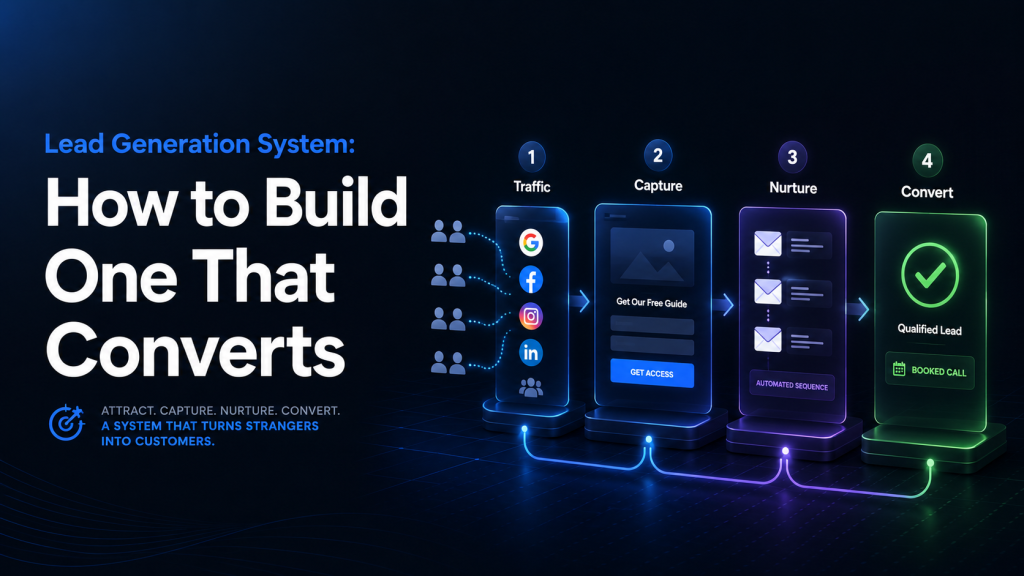
What a Lead Generation System Actually Includes
A lead generation system is not one tool, one campaign, or one landing page. It is the full process that turns attention into qualified sales opportunities.
At its simplest, the system has six parts:
- Traffic: How the right people find you through search, ads, referrals, social media, partnerships, or content.
- Offer: The reason someone takes action, such as a consultation, demo, quote, checklist, webinar, or discount.
- Capture point: The place where someone shares their information, such as a form, booking page, phone call, chatbot, or landing page.
- Qualification: The method you use to decide whether a lead fits your ideal customer profile.
- Follow-up: The emails, calls, texts, CRM reminders, or sales actions that move the lead forward.
- Tracking: The data that shows which channels, offers, and follow-up steps produce real customers.
These parts need to work together. A great ad will not help much if the landing page feels unclear. A strong form will not matter if nobody follows up. A packed CRM still creates little value if your team cannot tell which leads deserve attention first.
A real lead generation system connects each step, so prospects do not fall through the cracks. The system gives your business a repeatable way to attract interest, capture demand, and turn that demand into sales conversations.
This also connects to the broader pillar topic of digital marketing strategy. Lead generation sits between visibility and sales. Your marketing attracts attention, but your lead generation system gives that attention somewhere useful to go.
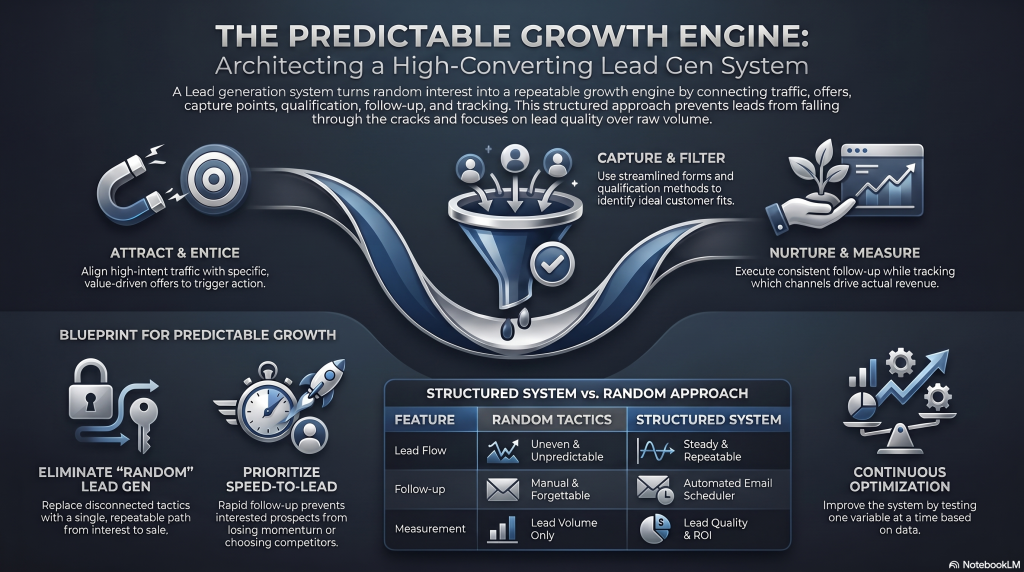
Why Random Lead Generation Fails Without a System
Random lead generation usually starts with good intentions. A business runs a few ads, posts on social media, sends emails, or adds a contact form to the website. Each tactic may help, but the results stay uneven when nothing connects.
A system fixes that problem because it gives every tactic a job. Traffic should bring in the right people. The offer should give them a clear reason to respond. The capture point should collect the right details. The follow-up process should move the lead toward the next step.
Without that structure, several problems show up fast:
- Leads come from the wrong audience, which wastes time for sales teams.
- Offers feel too vague, so visitors leave without taking action.
- Forms collect too little information, which makes qualification harder.
- Follow-up happens too slowly, so interested prospects lose momentum.
- Marketing tracks lead volume, but not lead quality or closed revenue.
This is why more traffic does not always mean more growth. A business can attract plenty of visitors and still struggle if the system does not guide people toward action.
A lead generation system turns scattered effort into a clear path. It helps your team understand where leads come from, what they want, how ready they are, and what should happen next.
How a Lead Generation System Moves Prospects From Interest to Sales
A lead generation system works by giving prospects a clear path from first interest to sales readiness. It does not force people to buy right away. Instead, it helps them take the next logical step based on their needs, timing, and level of trust.
The path usually starts when someone discovers your business through a marketing channel. They may find a blog post, click an ad, see a social post, hear about you from a referral, or visit your website after searching for a solution.
From there, the system guides them toward an action. That action might be requesting a quote, booking a call, downloading a guide, joining a webinar, or asking for a demo. The key is simple: the action must match where the prospect is in the buying journey.
Attracting the right audience
The first job of the system is to bring in people who are likely to need your offer. This starts with clear positioning. You need to know who you serve, what problem they have, and why they would choose your solution.
Search content, paid ads, social media, referrals, and partnerships can all drive traffic. However, each channel should point to the same core message. When your message stays consistent, prospects understand what you do faster.
Capturing contact information
Once the right person shows interest, the system needs a simple way to capture their information. This can happen through a form, phone call, booking page, quote request, chatbot, or lead magnet.
The capture point should ask for enough information to support the next step. Too many fields can scare people away. Too few fields can make the lead hard to qualify. A good form finds the middle ground.
Qualifying and nurturing leads
Not every lead is ready to buy today. Some need more information. Some need approval from a team. Some are a poor fit, and that is useful to know early.
Qualification helps you understand fit, urgency, budget, need, and decision timing. Nurturing keeps the relationship moving through emails, calls, retargeting, reminders, or helpful content.
The goal is not to chase every lead with the same message. The goal is to guide each lead based on where they are. That is where a system earns its keep.
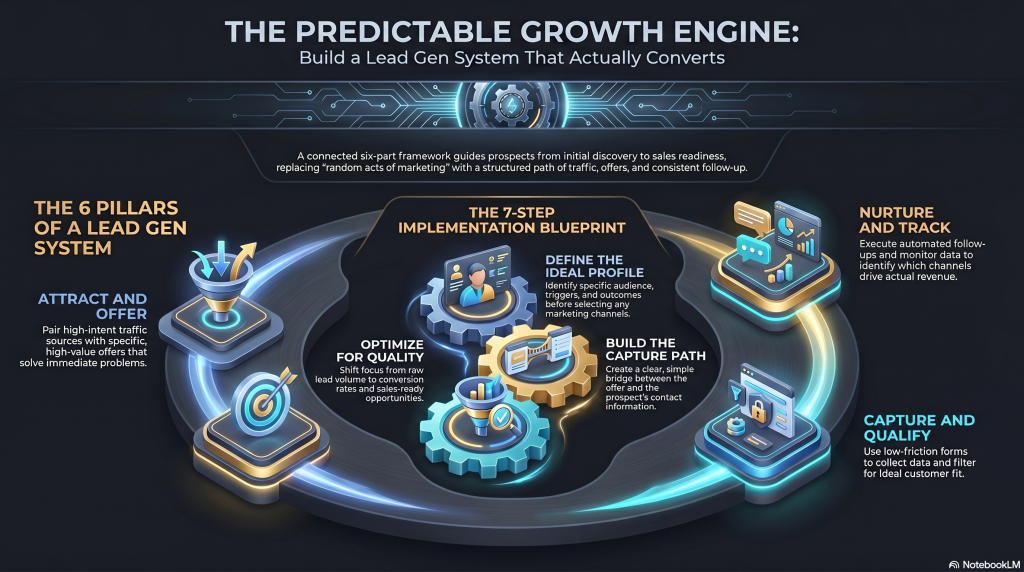
How to Build a Lead Generation System Step by Step
A lead generation system works best when you build it in order. Start with the customer, then build the path that moves that person from interest to action.
Step 1. Define the ideal customer
Start by deciding who the system should attract. A clear ideal customer helps you write better messaging, choose stronger channels, and avoid leads that waste time.
Focus on the basics:
- Who has the problem you solve?
- What triggers them to look for help?
- What outcome do they want?
- What makes them a good fit for your business?
This step matters because every later decision depends on it. If the audience is too broad, the system becomes noisy.
Step 2. Choose the main traffic source
Next, decide where your leads will come from. You do not need every channel at once. In fact, too many channels can make the system harder to manage.
Common traffic sources include:
- Google search
- Paid ads
- Social media
- Referrals
- Partnerships
- Organic content
Pick the channel that best matches your audience’s behavior. If people search for your service when they need it, SEO or search ads may work well. If trust drives the sale, referrals, content, and partnerships may matter more.
Step 3. Create the offer
The offer gives people a reason to take action. It should feel specific, useful, and connected to the problem they want to solve.
Examples include:
- Request a quote
- Book a consultation
- Download a guide
- Get a free audit
- Watch a demo
- Join a webinar
- Schedule an assessment
The best offer matches intent. A ready-to-buy prospect may want a quote. A research-stage prospect may want a guide or checklist first.
Step 4. Build the capture path
The capture path turns interest into a lead. This could be a landing page, form, phone call, booking page, chatbot, or contact page.
Keep this step simple. Tell the prospect what they will get, what information you need, and what happens after they submit.
A clear capture path reduces friction. A confusing one quietly sends good prospects elsewhere.
Step 5. Set up follow-up
Follow-up keeps the lead moving. Once someone reaches out, your system should tell your team what to do next.
That may include:
- Sending an instant confirmation email
- Assigning the lead in a CRM like HubSpot, Salesforce, or Pipedrive
- Connecting website forms to your CRM with a tool like Zapier or Make
- Calling the lead within a set time
- Sending a reminder if they do not respond
- Adding the lead to a nurture email sequence
The goal is consistency. A lead should never depend on someone remembering to check an inbox at the right moment.
Step 6. Track lead quality
Lead volume only tells part of the story. You also need to know whether those leads become real opportunities.
A CRM like HubSpot, Salesforce, or Pipedrive can help you track where leads come from, who followed up, and what happened next. Google Analytics can also show which pages and channels drive form submissions or calls.
Track details like:
- Lead source
- Offer used
- Contact method
- Sales status
- Close rate
- Revenue from each channel
This helps you separate busywork from growth. A channel that brings fewer leads may still win if those leads close at a higher rate.
Step 7. Improve the system over time
A lead generation system is not finished after launch. You improve it by watching where leads drop off and testing better options.
You can adjust the offer, simplify the form, improve follow-up, refine targeting, or shift budget toward stronger channels.
Small improvements can compound over time. That is the beauty of a system. It gives you something to measure, fix, and scale.
Lead Generation Mistakes That Cost You Good Prospects
A lead generation system can look polished and still lose strong prospects. The problem usually sits in the handoff between interest and follow-up.
Most mistakes happen because the business focuses on getting more leads before fixing how those leads move through the system.
Targeting too broad of an audience
A broad audience may feel safer, but it often creates weaker leads. When the message tries to speak to everyone, it rarely speaks clearly to anyone.
A better system starts with a specific customer profile. This helps your content, ads, offers, and follow-up feel more relevant from the first touch.
Using an offer that feels too vague
People need a clear reason to share their information. “Contact us” can work for ready buyers, but it often falls flat for people who still need more confidence.
A stronger offer tells the prospect what they get next. A quote, consultation, audit, demo, checklist, or assessment gives the action more value.
Asking for too much too soon
Long forms can slow people down, especially when they do not yet trust the business. Every extra field adds friction.
Ask for what you need to take the next step. You can collect more details later once the conversation starts.
Following up too slowly
Speed matters after a lead shows interest. A slow response gives the prospect time to forget, compare other options, or choose a competitor.
A good system routes the lead quickly and gives the team a clear next action. Nobody should have to hunt through inboxes to figure out what happened.
Tracking leads without tracking quality
Lead volume can look impressive, but it does not prove the system works. A campaign that brings many weak leads may drain more time than it creates value.
Track which leads become conversations, opportunities, and customers. That gives you a clearer view of what actually drives growth.
Changing too many things at once
Lead generation improves through testing, not guessing. When you change the audience, offer, landing page, and follow-up at the same time, you make results harder to understand.
Adjust one part at a time when possible. That helps you see what improved the system and what still needs work.

When Your Business Actually Needs a Lead Generation System
A business needs a lead generation system when growth depends on turning interest into sales conversations. This is especially true when the sale takes more than one step.
If someone can buy instantly from your website, a simple checkout path may do most of the work. But if prospects need a quote, consultation, demo, proposal, or follow-up call, you need a system that guides them there.
A lead generation system makes the most sense when:
- Your leads come from several channels, and you need to know which ones work.
- Your sales team spends too much time chasing poor-fit prospects.
- Your website gets traffic, but not enough inquiries.
- Your follow-up process depends on memory, inbox checks, or manual reminders.
- Your business sells a service, high-ticket offer, or complex solution.
- Your sales cycle takes days, weeks, or months.
This applies to many service-based and relationship-driven businesses. Agencies, consultants, contractors, financial service firms, software companies, medical practices, law firms, and B2B companies often need more than a basic contact form.
The simple test is this: if a good prospect needs to raise their hand before becoming a customer, you need a reliable way to capture, qualify, and follow up with that person.
Without that system, good leads can slip away quietly. No drama. No warning. Just fewer sales conversations than your marketing should have created.

Lead Generation System Examples for Different Businesses
A lead generation system should match how your customers buy. A local service business, B2B company, and consultant may all use the same basic system, but each one needs a different offer, capture point, and follow-up process.
| Business Type | Main Traffic Source | Best Lead Offer | Capture Point | Follow-Up Focus |
|---|---|---|---|---|
| Local service business | Google search, local SEO, paid ads, referrals | Quote, appointment, inspection, or estimate | Service page, location page, phone call, or booking form | Fast response by phone, text, or email |
| B2B company | SEO content, ads, webinars, case studies, LinkedIn | Demo, consultation, guide, or comparison resource | Landing page, demo form, or gated resource | CRM assignment, lead scoring, nurturing, and sales outreach |
| Consultant or agency | Blog content, LinkedIn, referrals, case studies, email | Strategy call, audit, assessment, or workshop | Booking page, intake form, or service page | Fit review, consultative follow-up, and nurture emails |
These examples show why a lead generation system should not copy one fixed template. The structure stays similar, but the details change based on the buyer’s urgency, the sales cycle, and the amount of trust needed before someone takes action.
Conclusion
A lead generation system gives your business a clear way to turn interest into sales opportunities. It connects the pieces that often sit apart: traffic, offers, capture points, qualification, follow-up, and tracking.
The real value comes from consistency. Instead of hoping the next campaign brings better leads, you can see where prospects come from, how they respond, and what helps them move forward.
A strong system does not need to be complex. It needs to match your audience, your offer, and your sales process. Start with one clear customer, one strong offer, one reliable capture path, and one follow-up process your team can actually use.
Once those pieces work together, you can improve the system over time. That is how lead generation becomes less random and more predictable.

Frequently Asked Questions
What is a lead generation system?
A lead generation system is the process a business uses to attract prospects, capture their contact information, qualify their interest, and follow up until they are ready for a sales conversation. It turns marketing activity into a repeatable path instead of a collection of disconnected tactics.
What are the main parts of a lead generation system?
The main parts are traffic, offer, capture point, qualification, follow-up, and tracking. Each part supports the next step. Traffic brings people in, the offer motivates action, the capture point collects information, and follow-up moves the lead toward a decision.
How do you build a lead generation system?
Start by defining your ideal customer. Then choose a traffic source, create a relevant offer, build a simple capture path, set up follow-up, track lead quality, and improve the system based on results.
What is the difference between a lead generation system and a sales funnel?
A sales funnel describes the journey from awareness to purchase. A lead generation system is the practical setup that captures and manages leads during that journey. The funnel shows the path, while the system runs the process.
What tools do you need for lead generation?
Most businesses need a website or landing page, a form or booking tool, a CRM, an email follow-up tool, and basic analytics. The exact tools depend on your sales process, but the goal stays the same: capture leads, organize them, and follow up consistently.

Ismel Guerrero
Internet Marketing · Artificial Intelligence
My name is Ismel Guerrero, and I help people start and grow their online business without the confusion and hype. After years of chasing complicated systems that led nowhere, I learned that success isn’t about shortcuts, it’s about clarity, consistency, and building on principles that last. Now I teach others how to do the same one simple step at a time.