AI can help you create a lead magnet in minutes. Making one people genuinely want still takes strategy.
The real advantage is not simply producing more content faster. It is using AI to develop stronger ideas, create polished assets, personalize your message, and test new approaches without spending days on every version.
In this guide, you will learn what AI-powered lead magnets are, how AI can help you create them, which tools are worth considering, and how to launch an effective lead magnet faster without sacrificing quality.
Key Takeaways
- AI can help you plan, write, design, personalize, and improve lead magnets without rebuilding every asset from scratch.
- Faster creation only matters when the final resource solves a clear problem and delivers something worth signing up for.
- Detailed prompts produce stronger results because they give AI the audience, goal, format, tone, and context it needs.
- AI-generated content should always be reviewed for accuracy, relevance, originality, and consistency with your brand.
- Personalization works best when it is based on meaningful information such as quiz answers, customer research, or clearly defined audience segments.
- AI makes it easier to create and test new titles, formats, examples, and calls to action, but real audience behavior determines what performs best.
- The strongest AI-powered lead magnets combine the efficiency of AI with human experience, judgment, and empathy.
Affiliate Disclosure: Some of the links on this site are affiliate links. That means if you click and make a purchase, I may earn a small commission at no extra cost to you. I only recommend tools and resources I genuinely believe in and that align with the content we share here.
What Exactly Is an AI-Powered Lead Magnet?
An AI-powered lead magnet is a resource created, enhanced, or optimized with the help of artificial intelligence.
It could be an eBook drafted with ChatGPT, a checklist designed with Canva AI, a quiz that generates personalized results, or a guide created from an existing blog post or video.
Instead of handling every part of the process manually, you can use AI to help with tasks such as:
- Generating and organizing ideas
- Writing or improving the content
- Repurposing existing material
- Creating layouts and visuals
- Adapting the message for different audiences
- Producing headlines and calls to action
- Suggesting variations to test
The biggest advantage is not that AI replaces the work. It helps you move through the work faster.
You still decide what your audience needs, what promise the lead magnet should make, and what information is accurate and worth including. AI helps turn those decisions into a finished asset with less time spent staring at a blank page or rebuilding every version from scratch.
That makes it easier to create more ideas, test different approaches, and improve your lead magnets without slowing down your entire marketing process.
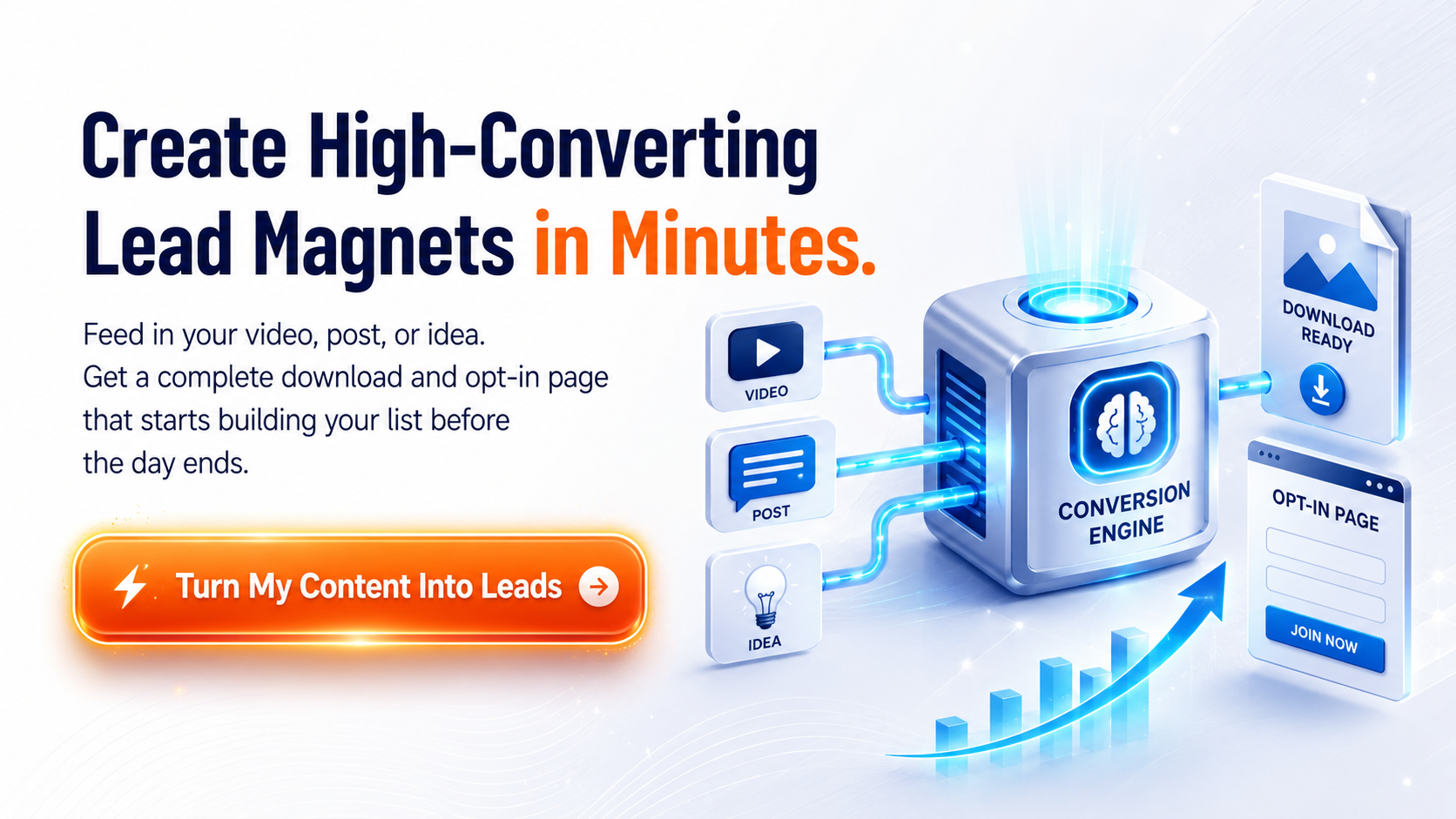
How AI Builds Lead Magnets in Minutes
You no longer need to start every lead magnet from a blank page.
With the right instructions, AI can help you move from a rough idea to a polished first version much faster by supporting the writing, structure, design, and personalization.
Start With a Clear Brief
Give the AI the information it needs to produce something relevant.
Include:
- The topic
- The target audience
- The problem you want to solve
- The result the reader should achieve
- The preferred format
- The tone and style
- The next action you want the reader to take
Create a five-step checklist for small-business owners who want to generate more leads through LinkedIn. Keep the language practical, include one example for each step, and end with an invitation to book a strategy call.
The more specific the brief, the less time you will spend fixing generic output later.
Generate the Structure and Content
AI can help create:
- Title ideas
- Section headings
- Step-by-step instructions
- Examples
- Checklists
- Calls to action
- Alternative versions
Start with the outline before generating the entire lead magnet. This gives you a chance to improve the flow, remove weak sections, and make sure the content delivers the promised result.
Once the structure is right, you can generate and refine each section individually.
Design and Format the Asset
Tools such as Beacon and Canva AI can help turn the content into a polished PDF, guide, checklist, workbook, or visual resource.
You can use AI-assisted features to generate:
- Layout ideas
- Visual concepts
- Images
- Page designs
- Brand-aligned color combinations
- Promotional graphics
The first design is only a starting point. Review the typography, spacing, visual hierarchy, branding, and mobile readability before publishing.
Adapt the Lead Magnet
AI can help you create different versions of the same core offer for separate audiences.
For example, one lead generation checklist could be adapted for:
- Coaches
- Consultants
- Freelancers
- Local businesses
- Software companies
You can also adjust the tone, examples, recommendations, or call to action based on the information you provide.
For more advanced lead magnets, quiz answers or form responses can be used to produce personalized results.
Publish and Connect the Campaign
Once the content and design are complete, export the lead magnet or publish it as an interactive resource.
Then connect it to:
- A landing page
- An opt-in form
- Your email platform
- A delivery email
- A follow-up sequence
- Your analytics or tracking tools
Before launching, test the entire experience. Make sure the form works, the correct file or result is delivered, the links open properly, and the lead magnet is easy to use on both desktop and mobile.
What once required several separate tools and long production cycles can now happen much faster.
AI handles much of the initial creation work, while you guide the strategy, accuracy, and final quality.
What Makes AI-Powered Lead Magnets Convert Better
Speed helps you launch faster. But speed alone does not persuade someone to subscribe.
The real advantage of AI-powered lead magnets is the ability to create more relevant offers, test stronger ideas, and improve the experience based on how people respond.
1. Precision Personalization
Generic lead magnets try to speak to everyone. AI makes it easier to tailor the message for different audiences.
You can adapt:
- The examples
- The tone
- The recommendations
- The call to action
- The level of detail
- The final result
A fitness coach might create separate versions for beginners and experienced athletes. A software company could tailor a guide for small businesses, agencies, or larger teams.
Interactive lead magnets can take this even further. A quiz or assessment can use someone’s answers to provide a more relevant result instead of sending every subscriber the same generic resource.
The more closely the offer reflects the reader’s actual situation, the more useful it feels.
2. Data-Informed Creative Choices
AI can help you make better creative decisions when you provide it with useful information.
That information may include:
- Search queries
- Survey responses
- Customer questions
- Email engagement
- Previous campaign results
- Quiz answers
- Sales conversations
AI can organize that data, identify recurring themes, and suggest titles, hooks, examples, or formats worth testing.
It cannot know with certainty what will convert before you publish. But it can help you move beyond guesswork by turning the information you already have into stronger possibilities.
3. Faster Testing and Optimization
Creating several versions of a lead magnet manually can take days. AI can generate variations in minutes.
You can test:
- Different titles
- Alternative promises
- Shorter or longer formats
- New calls to action
- Different audience angles
- Personalized result pages
- Revised landing-page copy
This gives you more opportunities to learn what your audience responds to without rebuilding the entire campaign from scratch.
AI does not replace testing. It makes testing faster and easier.
4. Scale Without Repeating the Entire Process
Once you create a strong lead magnet, AI can help you adapt it for new audiences, industries, channels, or formats.
A detailed guide could become:
- A checklist
- A short email course
- A quiz
- A workbook
- A set of social posts
- A version for a different customer segment
This allows you to get more value from one strong idea while keeping the core message consistent.
Each version still needs human review, but AI reduces the amount of work required to create it.
5. Human Insight Makes the Difference
AI can help with structure, speed, personalization, and variation. It cannot replace your understanding of the audience.
You still need to decide:
- Which problem is worth solving
- What promise will feel valuable
- Which examples are accurate
- What advice is genuinely useful
- What action should come next
The strongest lead magnets combine AI’s speed with your experience, judgment, and empathy.
That combination is what gives AI-powered lead magnets their real conversion advantage: faster creation, stronger relevance, and more opportunities to improve based on real audience behavior.
Best AI Tools for a Faster Lead Magnet Workflow at a Glance
Not every useful AI tool is built specifically for lead magnets. Some can help you research the topic, organize your ideas, draft the content, improve the writing, or create the final design.
Here are several options that can make different parts of the process faster:
| AI Tool | Best For |
|---|---|
| ChatGPT | Brainstorming ideas, creating outlines, drafting sections, refining copy, and analyzing campaign data you provide |
| Claude | Organizing detailed source material, developing long-form content, and reviewing complex documents |
| Perplexity | Researching topics, discovering sources, and gathering information with citations that you can verify |
| Canva AI | Creating layouts, visuals, branded designs, and promotional graphics |
| Notion AI | Organizing research, summarizing notes, improving drafts, and managing the creation workflow in one workspace |
You do not need all five. Choose the tool that removes the biggest bottleneck in your current process.
For a deeper comparison of platforms used to create, promote, deliver, and automate lead magnets, read our guide to the best lead magnet tools.

AI-Powered Lead Magnet Examples in Action
AI-powered lead magnets can take many forms. The right approach depends on what your audience needs and what action you want them to take next.
The following examples are illustrative scenarios rather than documented case studies. They show how different businesses could use AI throughout the creation and delivery process.
1. A Coach Creates a Personalized Action Plan
A business coach could create a short assessment that asks visitors about their goals, current challenges, available time, and level of experience.
AI could then use those answers to generate a personalized action plan with:
- The three priorities to focus on first
- Common mistakes to avoid
- Recommended next steps
- A relevant invitation to book a consultation
Instead of receiving the same PDF as everyone else, each subscriber gets advice connected to their current situation.
The coach still needs to define the questions, review the recommendations, and make sure the advice reflects their real methodology.
2. A SaaS Company Adapts One Guide for Several Industries
A software company may serve customers in healthcare, education, finance, and professional services.
Rather than writing a completely separate guide for every market, the company could use AI to adapt one core resource with:
- Industry-specific examples
- Relevant terminology
- Different use cases
- Tailored objections
- More appropriate calls to action
The central strategy remains consistent, but each version feels more relevant to the intended reader.
This approach works best when the company supplies accurate industry information instead of asking AI to invent the details.
3. An Online Store Builds a Product Recommendation Quiz
An online fitness retailer could create a quiz that helps shoppers identify the right training equipment for their goals.
The quiz might ask about:
- Experience level
- Preferred workout style
- Available space
- Budget
- Training goals
Based on those answers, the lead magnet could provide a personalized equipment checklist, training suggestions, and relevant product recommendations.
This gives the subscriber an immediate result while helping the business understand what the person is interested in.
The recommendations should remain useful and honest rather than directing every participant toward the most expensive product.
4. A Marketing Agency Repurposes Existing Content
A marketing agency may already have years of blog posts, webinar recordings, client questions, and internal frameworks.
AI could help organize that material into a practical toolkit containing:
- A campaign-planning checklist
- A content calendar
- A messaging worksheet
- A collection of reusable prompts
- A short implementation guide
The agency saves time by starting with proven material rather than producing everything from scratch.
Human review remains essential to remove outdated advice, combine overlapping ideas, verify claims, and add the agency’s genuine experience.
5. A Consultant Creates an Interactive Readiness Assessment
A consultant could build an assessment that helps prospects determine whether they are ready to begin a specific project, such as hiring a team, implementing new software, or launching a new service.
After answering several focused questions, each participant could receive:
- A readiness score
- An explanation of the result
- The main gaps to address
- A recommended sequence of actions
- A relevant next step
This type of lead magnet provides value before the sales conversation while helping the consultant identify which prospects may need immediate support and which need more preparation.
These examples show that AI does not need to replace the entire creation process to be useful.
It can help businesses turn one strong idea into a more relevant, practical, or personalized experience. The strongest results still come from combining AI with accurate information, thoughtful positioning, and a clear understanding of the audience.
How to Create Your First Lead Magnet With AI
By now, you have seen what AI can help you create. The next step is turning that possibility into a lead magnet your audience will actually find useful.
You do not need to master every AI tool or build a complicated workflow. Start with one clear problem, create a strong first version, and improve it with real feedback.
Step 1: Choose One Clear Goal
Before opening an AI tool, decide what the lead magnet should accomplish.
Do you want to:
- Grow your email list?
- Generate leads for a service?
- Help prospects understand a problem?
- Segment subscribers by interest or readiness?
- Move readers toward a consultation, trial, or offer?
Then define the result for the subscriber.
Ask: What should someone be able to understand, decide, create, calculate, or complete after using this lead magnet?
A clear result gives both you and the AI a stronger direction.
Step 2: Choose the Right Format
The format should match the problem you are helping the audience solve.
For example:
- Checklist: Helps someone complete a process without missing important steps
- Guide: Explains a topic or strategy in more depth
- Template: Helps the subscriber create something faster
- Quiz or assessment: Provides a score, recommendation, or personalized result
- Calculator: Produces an estimate based on the user’s inputs
- Toolkit: Brings several useful resources together in one place
Choose the simplest format that can deliver the promised result clearly.
Step 3: Give AI a Detailed Brief
Generic prompts usually produce generic lead magnets.
Give the AI enough context to understand the audience, problem, format, and desired outcome.
Create a five-step checklist for small-business owners who want to generate more leads through LinkedIn. Keep the language practical, include one example for each step, and end with an invitation to book a strategy call. Do not invent statistics, testimonials, or case studies. Flag any claims that should be verified.
You can also provide:
- Your audience research
- Customer questions
- Existing blog posts
- Notes from sales calls
- Your brand voice
- Personal examples
- Your framework or process
The more useful information you provide, the more relevant the output can become.
Step 4: Build the Structure Before the Full Draft
Ask AI to create the outline first.
Review:
- The title
- The promise
- The section order
- The depth of each part
- The examples
- The next step
Remove anything generic, repetitive, or unnecessary before generating the full content.
Once the structure feels right, you can generate and refine each section individually. This gives you more control and makes it easier to correct weak ideas before they spread through the entire resource.
Step 5: Add Your Expertise and Review the Content
AI can produce a workable draft, but the final lead magnet should reflect your knowledge.
Add:
- Real examples
- Firsthand observations
- Original recommendations
- Lessons from your experience
- Clear explanations your audience will understand
Then review the draft carefully.
Check:
- Does it fully deliver the promised result?
- Is the advice specific and practical?
- Are the facts accurate?
- Are any examples or statistics invented?
- Does the language sound like your brand?
- Is anything repeated unnecessarily?
- Does every section help the reader move forward?
This is the step that turns AI-generated material into something credible and useful.
Step 6: Design and Brand the Lead Magnet
Use a platform such as Canva, Beacon, or another design tool to turn the content into a polished resource.
Apply:
- Your logo
- Brand colors
- Consistent fonts
- Clear headings
- Comfortable spacing
- Relevant visuals
- Easy-to-follow page layouts
Strong content earns attention. Good design makes that content easier to understand and use.
Review the finished asset on both desktop and mobile. Make sure the text is readable, the pages are not overcrowded, and every visual supports the message.
Step 7: Add a Clear Next Step
A lead magnet should help the subscriber solve an immediate problem while naturally leading to the next useful step.
That might be:
- Joining your newsletter
- Downloading a related resource
- Booking a consultation
- Trying a tool
- Viewing a relevant product
- Completing another exercise
The call to action should feel connected to the content rather than added as an unrelated sales pitch.
Now that you have identified the gaps in your lead generation process, book a strategy call to build a plan around your business, audience, and goals.
Step 8: Publish, Promote, and Test the Experience
Connect the lead magnet to your landing page, opt-in form, email platform, and follow-up sequence.
Before promoting it, test the entire journey:
- Submit the form yourself
- Confirm that the delivery email arrives
- Open the file or personalized result
- Test every link
- Check the mobile experience
- Confirm that tags and automations work
- Review the consent and privacy language
Then promote the lead magnet through the channels your audience already uses, such as blog posts, social media, email, website banners, relevant partnerships, and paid campaigns.
Track the response and use what you learn to improve the title, promise, format, CTA, or follow-up.
What once required several separate tools and long production cycles can now happen much faster. AI handles much of the initial creation work, while you guide the strategy, accuracy, and final quality.

Avoid These Common Mistakes
AI can speed up lead magnet creation, but moving faster does not automatically produce something useful.
These are the mistakes most likely to weaken the quality, accuracy, and credibility of the final resource.
Publishing the First Draft
AI can produce a polished-looking draft in seconds, but that does not mean it is ready to publish.
The content may be repetitive, too broad, inaccurate, or disconnected from your audience’s real needs.
Fix: Treat the first output as raw material. Review the structure, remove generic advice, verify important claims, and rewrite anything that does not sound like you.
Using Vague Prompts
A broad prompt such as “Create a lead magnet for business owners” gives the AI very little direction.
The result will usually be broad too.
Fix: Include the audience, problem, desired result, format, tone, examples, and next step. The more useful context you provide, the less editing you will need later.
Letting AI Invent Facts or Proof
AI may generate statistics, quotations, examples, testimonials, or case studies that sound believable but are not real.
Publishing them without checking can damage trust quickly.
Fix: Verify every important claim. Remove any number, quotation, source, or result you cannot confirm. Never present an illustrative scenario as a documented case study.
Removing Your Own Expertise
A lead magnet built entirely from generic AI output may be clear, but it will rarely feel distinctive.
Your experience is what gives the resource depth and credibility.
Fix: Add your own frameworks, observations, examples, lessons, and recommendations. Use AI to organize and strengthen your knowledge rather than replace it.
Personalizing Without Reliable Information
AI can adapt content for different audiences, but it needs meaningful inputs.
Changing a few words does not create genuine personalization.
Fix: Base personalized versions on real information such as survey responses, quiz answers, customer research, campaign data, or clearly defined audience segments.
Ignoring Privacy and Confidentiality
Customer records, private client information, internal documents, and sensitive business data should not be added to an AI tool without understanding how that information will be handled.
Fix: Remove identifying or confidential details whenever possible. Review the platform’s privacy settings and data policies before uploading sensitive material.
Overlooking Design and Usability
A visually attractive lead magnet can still be difficult to read or use.
AI-generated layouts may include cramped pages, weak contrast, inconsistent formatting, or unnecessary visuals.
Fix: Review the final design on desktop and mobile. Check the font size, spacing, headings, colors, links, and page flow before publishing.
Creating More Instead of Creating Better
AI makes it easy to produce several lead magnets quickly. That does not mean every idea deserves to be launched.
Publishing too many weak offers can divide attention and make it harder to understand what your audience actually wants.
Fix: Start with one clear problem and one strong offer. Improve it using real results before creating several more versions.
Skipping Testing and Follow-Up
A lead magnet does not succeed simply because people download it.
The full campaign includes the landing page, delivery email, resource itself, follow-up messages, and next offer.
Fix: Test the complete experience and track what happens after the signup. Use the data to improve the title, promise, format, CTA, or follow-up sequence.
AI is most valuable when it supports good judgment.
Use it to move faster, explore more possibilities, and reduce repetitive work, but keep accuracy, usefulness, and trust under human control.
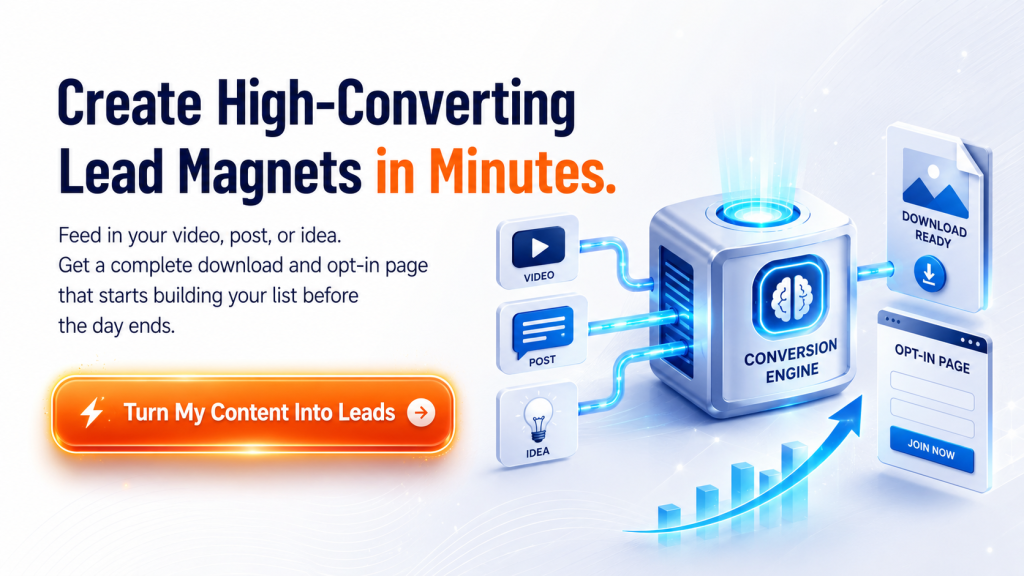
Conclusion: Use AI to Create Faster Without Losing What Matters
AI can help you move from idea to finished lead magnet faster than ever.
It can support the research, structure, writing, design, personalization, and testing. That gives you more freedom to explore ideas, create different versions, and improve your campaigns without rebuilding everything from scratch.
But the technology is only part of the process.
The strongest lead magnets still begin with a clear audience problem and a useful promise. They still need accurate information, thoughtful positioning, and a next step that makes sense for the subscriber.
Use AI to reduce the repetitive work and expand what you can create. Then add the experience, judgment, and understanding that make the final resource worth downloading.
Start with one problem your audience already wants to solve. Build the first version, review it carefully, launch it, and use the response to guide what comes next.
That is where AI becomes most valuable, not as a replacement for strategy, but as a faster way to put good strategy into action.
Frequently Asked Questions
What is an AI-powered lead magnet?
An AI-powered lead magnet is a free resource created, improved, personalized, or optimized with the help of artificial intelligence. It may be a guide, checklist, quiz, assessment, template, calculator, or another useful asset offered in exchange for contact information.
Can AI create an entire lead magnet?
AI can help with the idea, outline, writing, design, personalization, and testing. However, the final result still needs human review to confirm that the information is accurate, the advice is useful, and the content reflects your experience and brand.
Do AI-powered lead magnets convert better?
They can. AI makes it easier to create more relevant versions, personalize the experience, and test different titles, formats, and calls to action. But conversion still depends on the strength of the offer, the audience, the landing page, the traffic source, and the follow-up.
What types of lead magnets can I create with AI?
AI can help create:
- eBooks and guides
- Checklists and cheat sheets
- Templates and worksheets
- Quizzes and assessments
- Calculators and generators
- Toolkits and resource lists
- Personalized action plans
- Email courses
The best format is the one that helps your audience achieve a clear result as simply as possible.
Do I need technical or design skills?
Not necessarily. Many AI writing and design tools are beginner-friendly and include templates, editors, and guided workflows. You still need to review the content, make basic design decisions, and test the final signup and delivery experience.
Can AI personalize a lead magnet?
Yes, when you provide useful information such as quiz answers, customer segments, survey responses, goals, or campaign data. AI can then adapt examples, recommendations, tone, results, or calls to action for different users.
What should I review before publishing?
Check the facts, examples, statistics, links, design, mobile readability, delivery process, and call to action. Make sure the resource delivers the promised value and does not include invented proof, private information, or generic advice that could apply to anyone.